
A Jyotirlinga (Jyotirlingam) is a divine representation of Lord Shiva, the most beloved god in Hinduism. There are 12 Jyotirlinga in India; each is located in a different part of the country and represents the cosmic energy of Lord Shiva in the form of a shining lingam.
Unlike the many Shiva lingas made by Humans, 12 Jyotirlingas are believed to be Swayambhu (self-manifested) Shivlingas.
Holding immense spiritual significance, they are believed to be powerful sites of spiritual cleansing and purification, attracting millions of devotees across India.
Every year, many pilgrims visit these holy temples to seek divine blessings and to cleanse and purify their souls for the betterment of their lives. We also contribute to this sacred pilgrimage by providing the Kedarnath Yatra Tour Package to one of the Jyotirlingas.
In this guide, you will explore everything about the twelve Jyotirlingas, including their location, significance, how to get there, and everything that you need to know. So let’s start.
About 12 Jyotirlinga of Shiva in India
The 12 Jyotirlingas are the most revered and powerful shrines in Hinduism. Dedicated to Lord Shiva, this place represents the infinite and fierce energy that appeared as a divine light to bless Humanity.
The word “Jyotirlinga” derives from the Sanskrit word, which means “Pillar of Light”; these temples are believed to self-manifest (swayambhu shivlinga).
Twelve Jyotirlingas are the prime destinations, spanning across India, now become transformative pilgrimage sites, known as Jyotirlinga Yatra.
According to the legend of the Shiva Purana, once Lord Vishnu and Lord Brahma argued over who the supreme deity is, and their debate could have led to a threat to world peace. So to resolve their dispute, Lord Siva pierced the three worlds with infinite light, having no end.
Give a task to find the end of these worlds; whoever does it can be the supreme deity in the Universe.
Lord Vishnu took the form of Varaha and dived into the earth to find the end, while Lord Brahma took Hansa and flew to find the top. As a result, Lord Vishnu failed, and Lord Brahma also failed but lied that he found the top, and to prove his falsehood, he produced the Ketki flower.
Angry at the dishonesty of Brahma, Lord Shiva cursed him that he would never be worshipped in this world and cut off his fifth head with the tip of his nail, and announced that Grand Lord Vishnu would be worshipped in the Universe by his honesty.
To calm down, Lord Shiva manifested as the twelve Cosmic lights at specific locations on earth.
Map of 12 Jyotirlinga With Distance
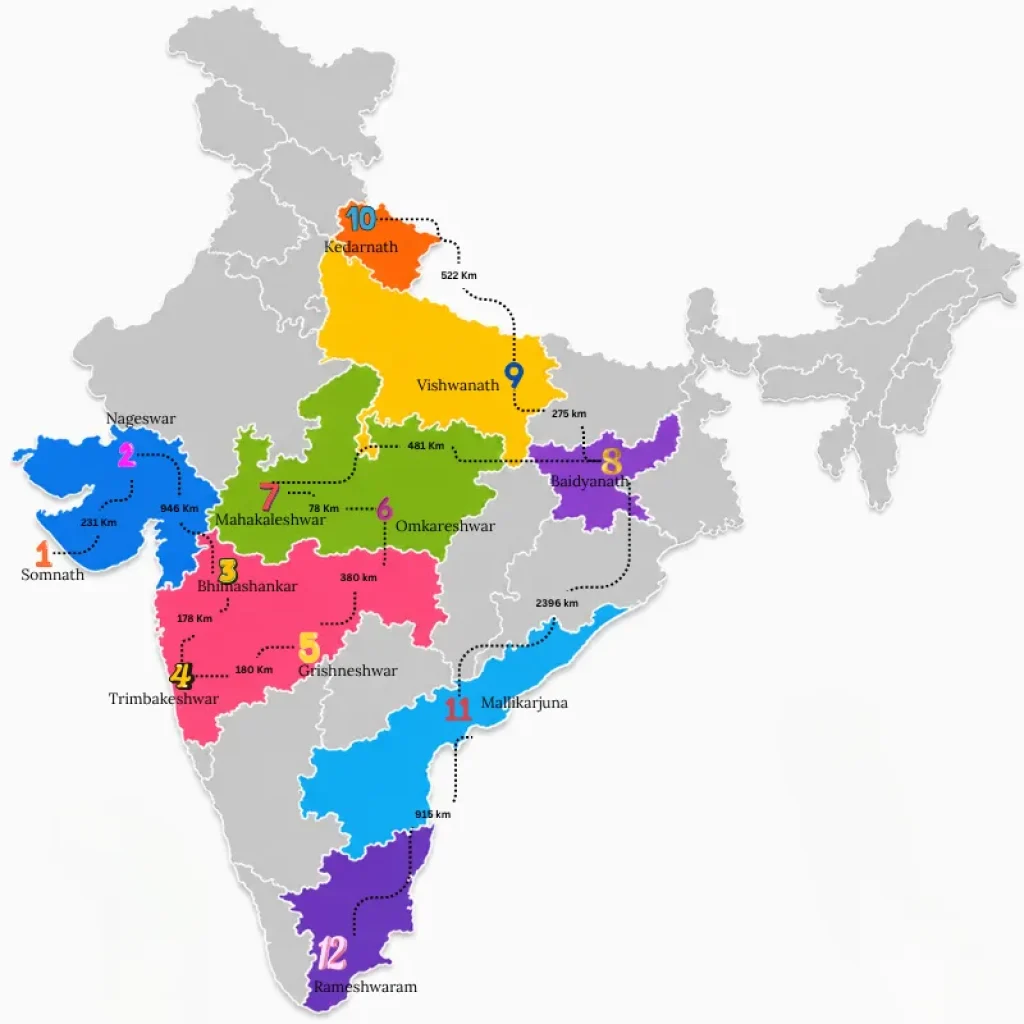
12 Jyotirlinga Name & Location
| Sr. No | Jyotirlinga Name | Location (State) | District |
| 1. | Somnath | Gujarat | Prabhas Patan, a town in Gir Somnath District |
| 2 | Mallikarjuna | Andra Pradesh | Srisailam in Nandyal District |
| 3 | Bheemashankar | Maharashtra | Pune |
| 4 | Mahakaleshwar | Madhya Pradesh | Ujjain |
| 5 | Omkareshwar | Madhya Pradesh | Khandwa district |
| 6 | Vaidyanath (Baidyanath) | Jharkhand | Deoghar district |
| 7 | Nageshwar | Gujarat | Dwarka |
| 8 | Kashi Vishwanath | Uttar Pradesh | Varanasi |
| 9 | Rameshwar | Tamil Nadu | Ramnathapuram |
| 10 | Trimbakeshwar | Maharashtra | Nashik |
| 11 | Kedarnath | Uttarakhand | Rudraprayag district |
| 12 | Grishneshwar Jyotirlinga | Maharashtra | Aurangabad district (now Chatrapati Sambhaji district) near the Elora caves |
How Many Jyotirlinga are in Gujarat?
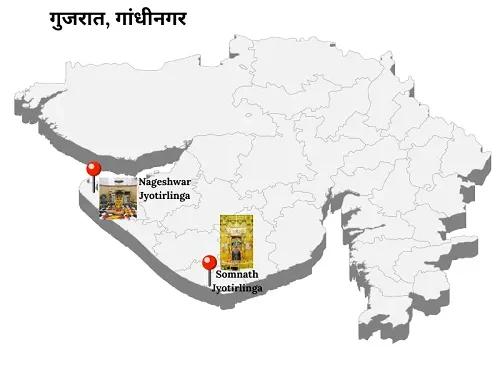
There are two Jyotirlingas in Gujarat out of twelve Jyotirlingas; the first is Somnath, which is located in the Gir Somnath district of Gujarat near Prabhas Patan town. It is renowned as the first and oldest among the 12 revered shrines.
Another jyotirlinga in Gujarat is Nageshwar, located in the Devbhoomi Dwarka district of the state. It is also known as the Nagnath temple, featuring the 82-foot-tall statue of Lord Shiva outside the temple.
Somnath: The First & Oldest Jyotirlinga
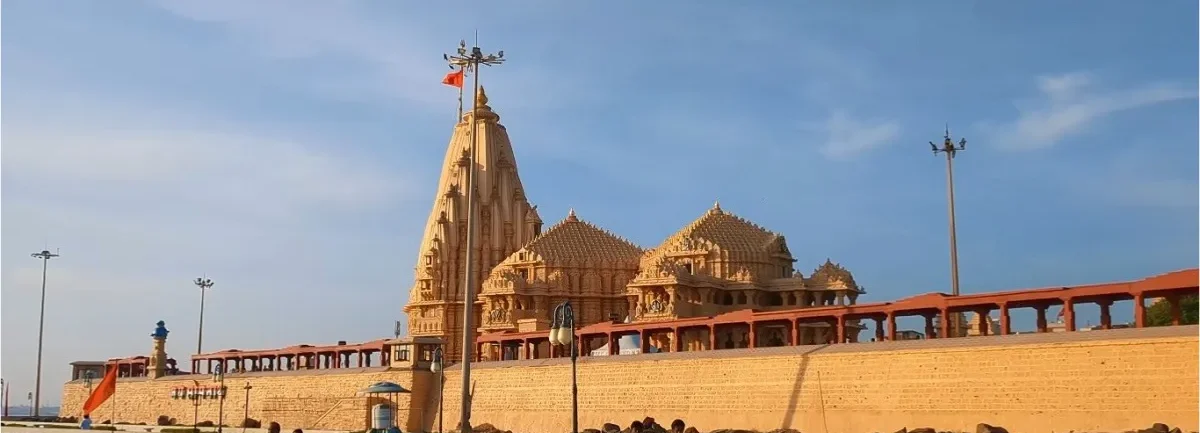
- State: Gujarat
- District: Prabhas Patan town of Gir Somnath District
- Nearest airport: Keshod Airport, around 50 km away
- Nearest railway station: Veraval Junction (VRL), just 5 km away, and Somnath railway station is another local station.
- Distance from Delhi: 1,411 km by road
- Nearby Attractions: Triveni Sangam, Panch Pandav Gufa, Balka Tirth temple, etc
Located in the Prabhas Patan town near Veraval of the Gir Somnath district of Gujarat, Somnath is one of the very first significant pilgrimage sites of the 12 Jyotirlinga.
Dedicated to Lord Shiva, the temple is revered for its rich mythology and stands as a powerful symbol of spiritual significance on the western coast of the Arabian Sea.
Mythological Story & Significance
According to Somnath Temple history, the temple was rebuilt by the moon God (Chandra Dev), who performed intense penance in Prabhas Kshetra near Triveni Sangam (Confluence of Kapila, Hiran, and Saraswati rivers).
Legends state that Chandra Deva married 27 daughters of King Daksha, but loved only Rohini and neglected the others. Angered by this injustice, King Daksha cursed him that he would lose his divine light and fade into nothingness.
By getting desperate to break this curse, Chandra Dev performed intense penance to Lord Shiva in this sacred region. Lord Shiva, pleased by his devotion, granted him a blessing that he could not completely be free from the curse, but modified it to create a timeline cycle where Chandra Dev wanes for 15 days (Krishna paksha) and gets back his light after 15 days, waxing (shukla paksha).
Today, the Somnath Temple is a powerful symbol of spiritual resilience.
Nageshwar: Famous as Nagnath Temple
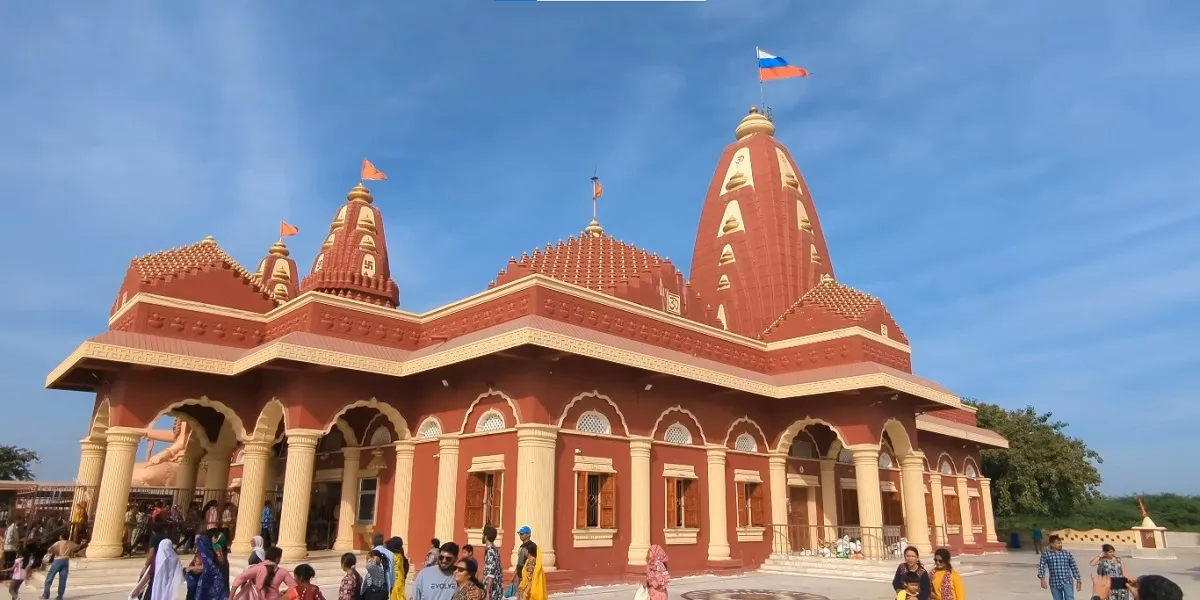
- State: Gujarat (coastal region of the state)
- District: Dwarka District, 17 km from the city centre
- Nearest Airport: Jamnagar Airport
- Nearest Railway Station: Dwarka Railway Station
- Distance from Delhi: Approx. 1,285 km by road
- Nearby Attractions: Dwarkadish temple, Shivrajpur beach, Gopt Talab, etc.
Nageshwar Jyotirlinga, or Nagnath temple, is one of the sacred pilgrimage sites in the Saurashtra region of Gujarat near the Dwarka District. Dedicated to Lord Shiva, it is the second Jyotirlinga in Gujarat among the 12 Jyotirlingas.
The word “Nageshwar” means the “god of serpents,” which represents the cosmic form of Lord Shiva to protect his devotees from all kinds of evil poisons.
Visiting Shri Nageshwar Jyotirlinga Temple frees devotees from the fear of death by serpent bite and also from spiritual poison, such as jealousy and anger.
Story & Significance
According to the Skanda Purana, the region was known as Darukwana Forest, which was terrorised by the demon couple Daruk and Daruki, who tormented the local sages and people of this region.
Once these demon couples imprisoned all the villagers in the deep water, a little Shiva devotee girl named Supriya continuously chanted the name of Lord Shiva. To execute the little girl, Daruka tried to crush her, but Lord Shiva took the form of divine light to protect his devotee and reside here forever as a self-manifested shivlinga.
This core legend makes it a prominent site for Shiv Devotees who visit this shrine to seek the divine blessings of Lord Shiva.
Mallikarjuna Jyotirlinga, Andhra Pradesh
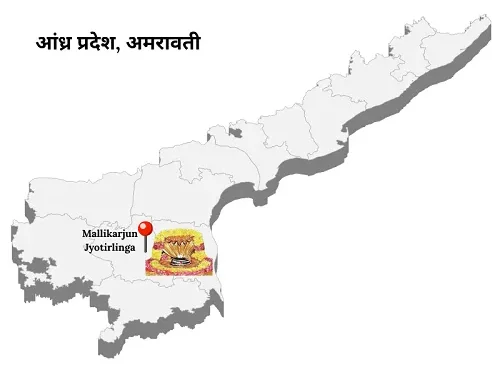
- State: Andhra Pradesh
- District: Srisailam (top of the Nallamal hills)
- Nearest Airport: Rajiv Gandhi International Airport in Hyderabad, around 230 km away
- Nearest railway station: Markapur station, around 85 km, and Hyderabad railway station is the primary station, around 245 km, and has great connectivity.
- Distance from Delhi: 1,811 km by road
- Nearby Attractions: Brahmarambha temple, Akkamahadevu caves, and Srisailam Dam
On the Nallamal hills of Srisailam, Andhra Pradesh, Mallikarjuna is a revered shrine dedicated to Lord Shiva and Devi Parvati. The site is known for its Jyotirlinga in the Srisailam Mallikarjuna Temple, situated on the banks of the Krishna River.
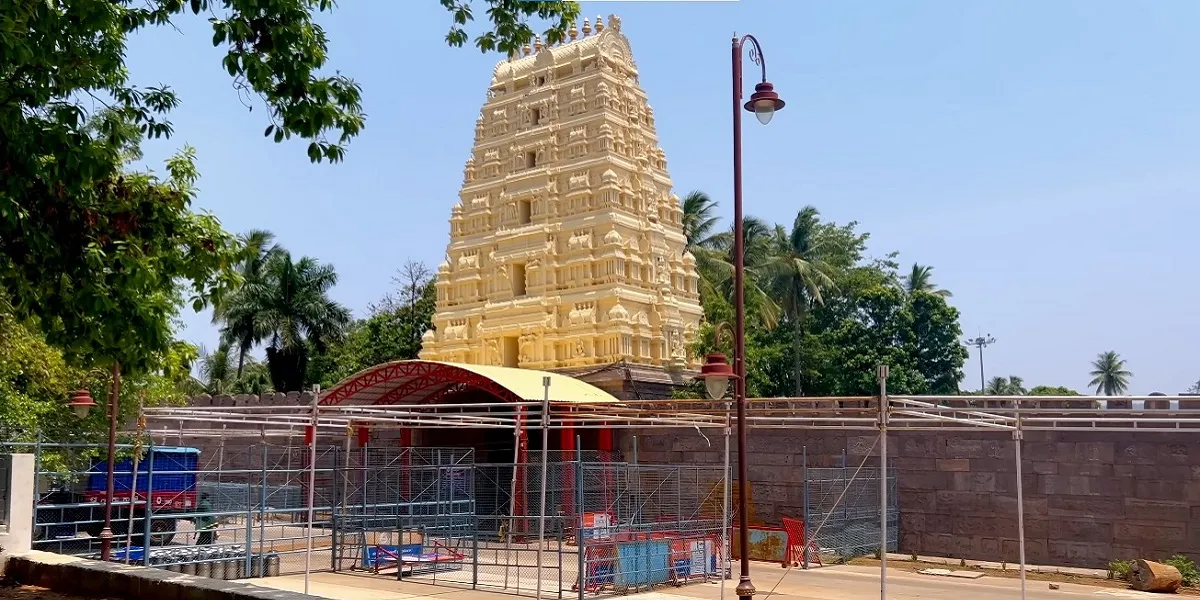
Mythological Significance
The site holds great significance for mythological connections and natural beauty, with the surrounding hills. Lord Shiva once gave a task to their sons, Kartikeya and Ganesha, to complete the seven circumambulations of the universe.
Kartikeya immediately flew off on his peacock, but Ganesha walked around his parents seven times, stating that his parents are his universe. Impressed by his ideology, he was declared the winner.
Upon this, Kartikeya felt cheated and heartbroken, decided to be celibate for life, and left Mount Kailash. Deeply grieved by their son’s departure, Lord Shiva and Maa Parvati went to comfort him.
It is believed that the Jyotirlinga here is Lord Shiva and Goddess Parvati, manifested as the divine forms Mallika (Parvati) and Arjuna (Shiva) for their son Kartikeya.
How Many Jyotirlingas are in Maharashtra?
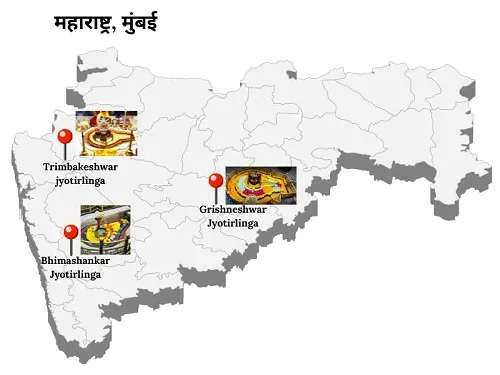
Maharashtra has the highest number of Jyotirlingas in India. There are three primary Jyotirlingas in Maharashtra out of 12 Jyotirlinga shrines. Spread all over the state, and their names are
Trimbakeshwar: Located in the Trimbak village, Bhimashankar is a significant site of Lord Shiva. It features a unique three-faced Shivlinga (representing the trinity: Brahma, Vishnu, and Shiva).
Bhimashankar: Situated in the Pune district of Maharashtra, Bhimashankar is another revered shrine among the twelve Jyotirlingas. It is renowned as the origin of the Bhima River near the temple.
Grishneshwar: Located in the Aurangabad district of Maharashtra near the famous Ellora Caves. It is the final (12th Jyotirlinga) ancient shrine of Lord Shiva. Featured as a five-tier shrine.
Here are detailed descriptions of all three Jyotirlingas in Maharashtra.
Trimbakeshwar Jyotirlinga Mandir
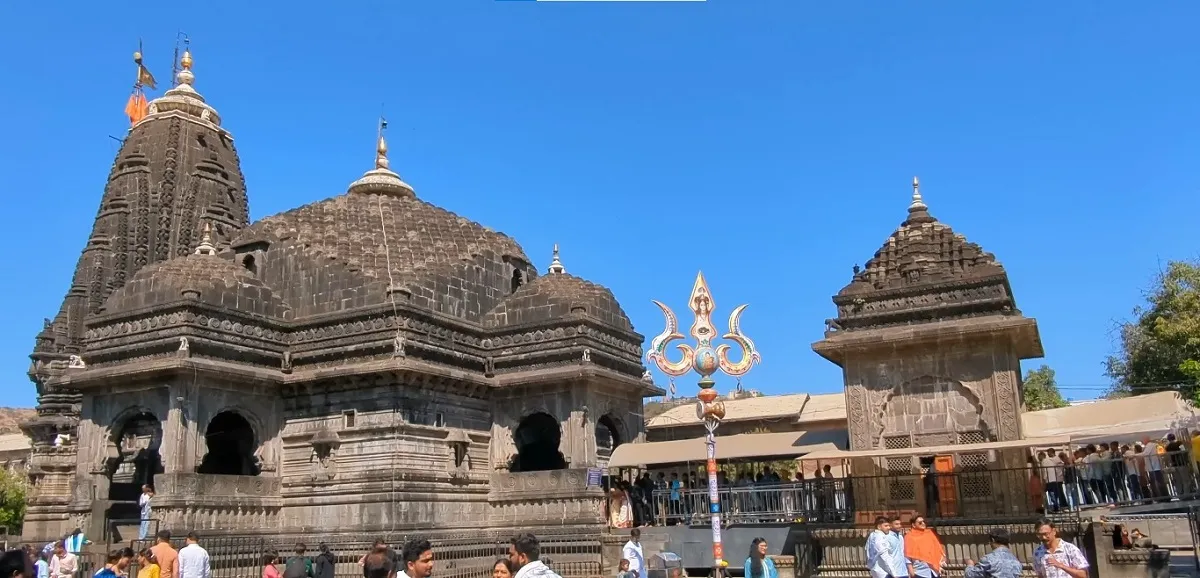
- State: Maharashtra (Within Brahmagiri mountains)
- District: Nashik district, around 27 km from there.
- Nearest Airports: Nashik Airport, around 35 km away, & Chatrapati Sambhaji Airport, approx. 200 km away has great connectivity
- Nearest Railway Station: Nashik Railway Station
- Distance from Delhi: 1,241km by road
- Nearby Attractions: Views of Brahmagiri hills & Kudya Falls
Situated in the foothills of the Brahmagiri hills, Trimbakeshwar is a revered Jyotirlinga of Lord Shiva. Located in the Nashik district of Maharashtra, it holds great significance, renowned as the birthplace of the Godavari River and featuring a unique three-faced Shivalinga that represents the trinity: Brahma, Vishnu, and Shiva.
Mythological Significance
According to ancient beliefs, a sage named Gautama performed intense penance to Lord Shiva to absolve the sins of Gauhatya and brought the Ganga River to descend on earth to purify his land.
Lord Shiva, pleased by his devotion, brought Ganga down, which flows here through the Brahmgiri hills as the Godavari River. Upon the sage’s request, Lord Shiva resides here, taking the form of Trimbakeshwar Jyotirlinga.
Bhimashankar Jyotirlinga
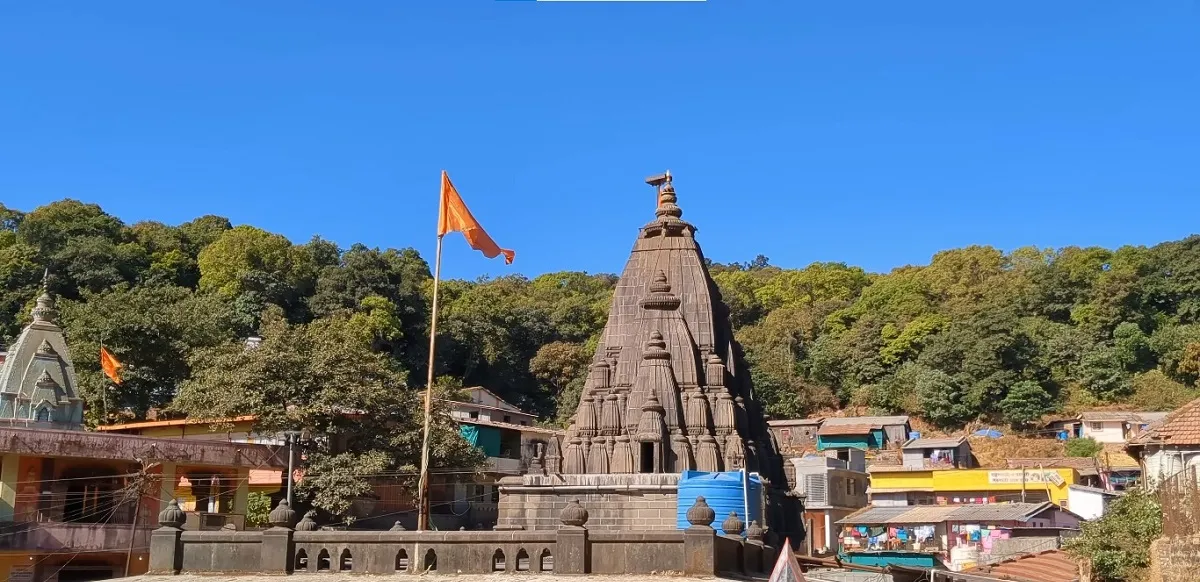
- State: Maharashtra (Within the Sahyadri hills)
- District: Bhorgiri village of Pune District
- Nearest Airport: Pune International Airport, around 100 km away
- Nearest Railway station: Pune Railway Station, approx. 110-120 km away
- Distance from Delhi: 1,472 km by road
- Nearby Attractions: Bhimashankar Wildlife Sanctuary, Bhima River source, Hanuman Lake
Nestled in the Sahyadri hills of Maharashtra, Bhimashankar is the ancient, revered shrine of Lord Shiva. It holds great significance as the origin of the Bhima River and is famous for its scenic wildlife sanctuary.
Mythological Significance
As per the legend, the origin of Bhima is tied to a demon named Bhima (son of Kumbhakarna), who took the vow to take revenge for his father’s death.
He performed intense penance to Lord Brahma and gained immense power. Spread wreckage in the three worlds and defeated a Shiv devotee, King Kamrushwar, and imprisoned him.
He tried to kill the king, but he continued chanting the name of Lord Shiva, who appeared as a divine cosmic light to protect his deity and stayed here forever, leading to the origin of Bhimashankar Jyotirlinga Temple.
Grishneshwar Jyotirlinga
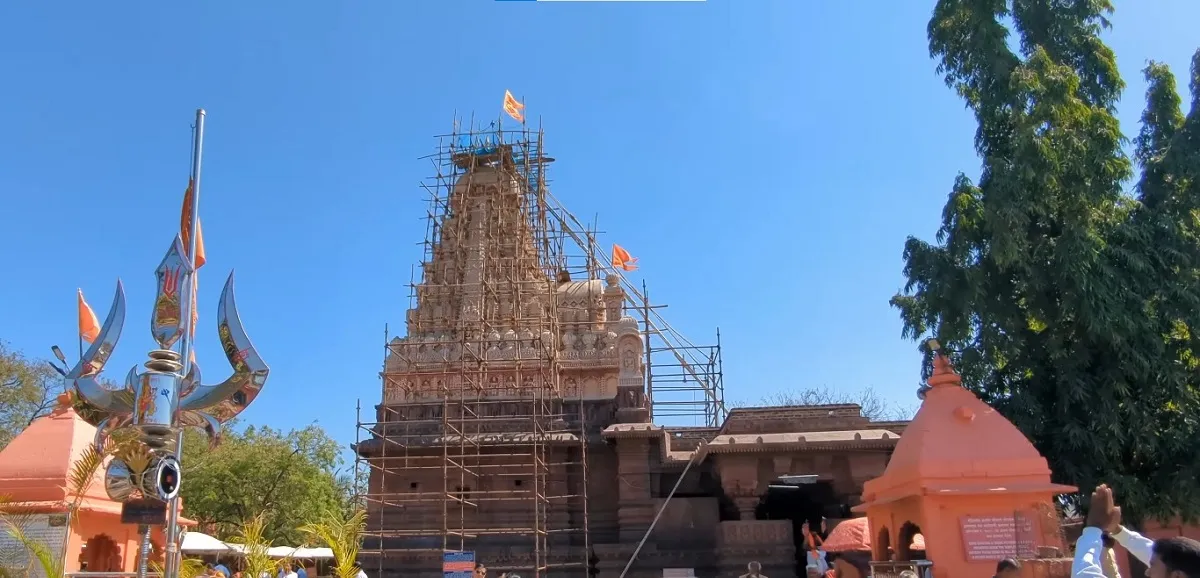
- State: Maharashtra
- District: Verul village, near Ellora Caves of Chatrapati Sambhaji District (formerly Aurangabad)
- Nearest Airport: Chatrapati Sambhaji Nagar Airport, around 35 km away.
- Nearest Railway Station: Aurangabad Railway Station (approx. 30 km away)
- Distance from Delhi: 1,171 km by road
- Nearby Attractions: Ellora & Ajanta Caves, Daulatabad Fort
Situated near the Ellora Caves in Chhatrapati Sambhaji Nagar, Maharashtra, Grishneshwar Mahadev is a sacred Jyotirlinga of Lord Shiva. It is also known as Ghumeshwar, which means “Lord of Compassion”.
Mythological Significance
It is tied to the ancient legend of the Shiva Purana, which states that once a Shiva devotee named Gushma resided in this region and worshipped Lord Shiva deeply. She had only one son, who was killed by her own sister, Sudeha, out of jealousy.
In this tragedy, Gushma prayed to Lord Shiva to bring her son’s life back. By pleasing her devotion, Shiva revived her son and, upon her request, resided here as a divine, fierce light to protect his devotees and compassion and empathy in the region.
How Many Jyotirlingas are in Madhya Pradesh?
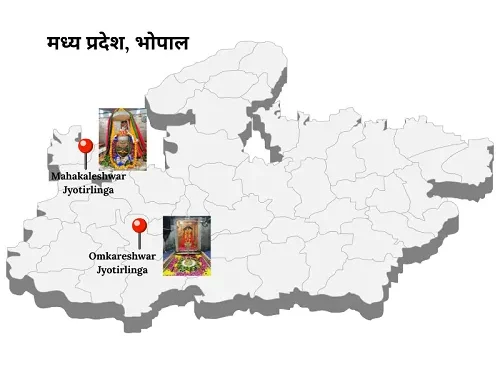
Madhya Pradesh is home to two Jyotirlingas out of the 12 Jyotirlinga in India. Their names are
Mahakaleshwar: Highly revered temple of Lord Shiva in Ujjain, Madhya Pradesh. Lord Shiva is worshipped here as Mahakaal, which means the lord of time and death.
Omkareshwar is named after its unique location in Mandhata Island on the Narmada River, which is shaped like the divine Om symbol.
Mahakaleshwar Jyotirlinga
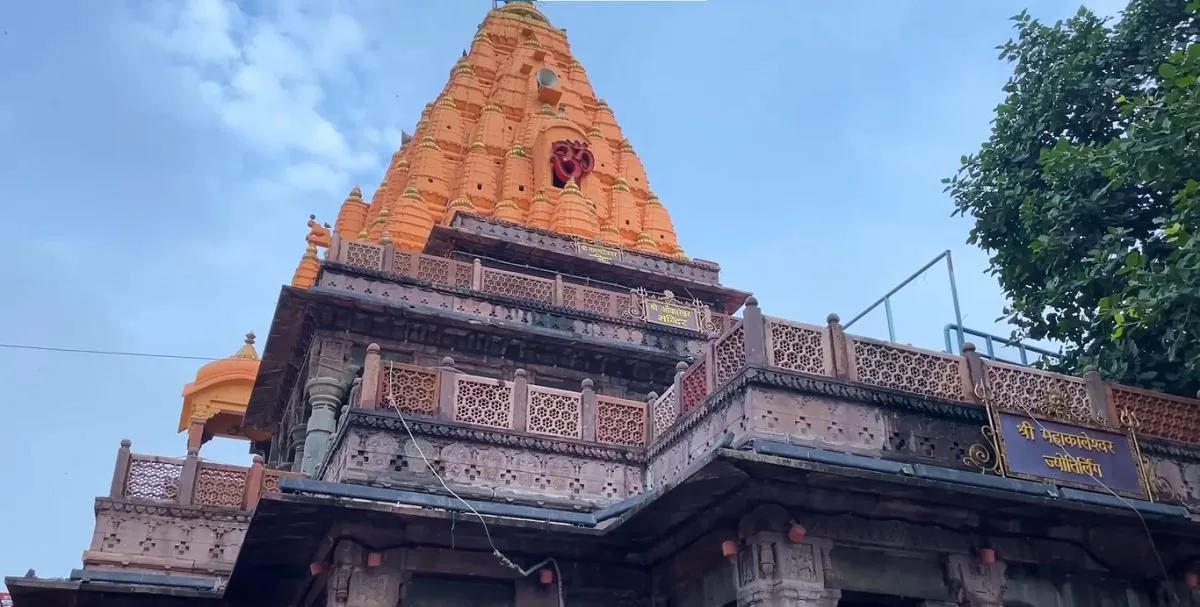
- State: Madhya Pradesh
- District: Holy city Ujjain
- Nearest Airport: Devi Ahilyabai Holkar Airport (Indore), around 55 km away
- Nearest railway station: Ujjain, just 2 km away
- Distance from Delhi: 716 km by road
- Nearby attractions: Harsidhi temple, Gadkalika temple, Kaal Bhairav mandir, Ram Ghat
Situated on the banks of the Shipra River and in the holy city of Ujjain, Mahakaleshwar is the sacred temple of Lord Shiva. It is renowned as the only dakshinmukhi Jyotirlinga (south-facing), showing lord shiva as having absolute command over time and death.
The Mahakaleshwar story & significance attract devotees from across India, who visit here to seek the divine blessings of deities. Widely famous for Bhasma Aarti.
Mythological Significance
In ancient times, Ujjain was known as Avantika, which was a huge hub of Vedic learning. A Brahmin named Vedapriya was conducting Vedic rituals and worshipping a Shivalinga along with his four sons.
Concurrently, a demon named Dushashan, obtaining immense power from Lord Brahma, terrorised this region to destroy religious harmony. He threatened the villagers to halt their prayers, but they neglected it and continuously prayed to Lord Shiva for protection.
Then, Lord Shiva emerges himself as a fierce form to kill the demon and to protect his devotees, and resides here permanently as the form of the powerful Jyotirlinga.
Omkareshwar Jyotirlinga
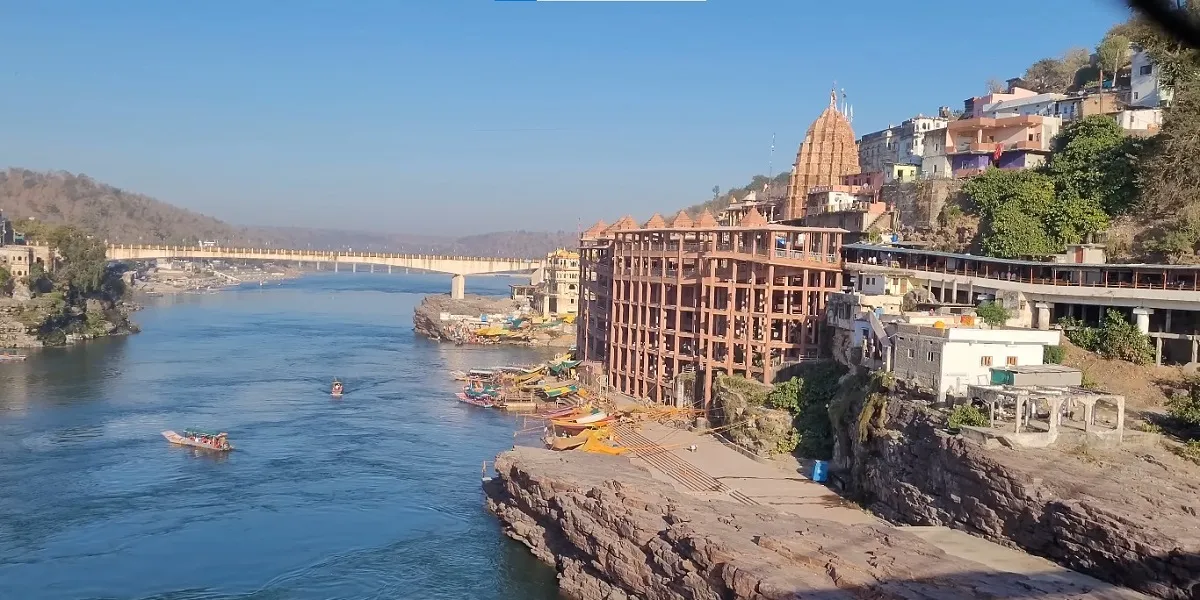
- State: Madhya Pradesh (Mandhata Island)
- District: Khandwa District, Indore
- Nearest Airport: Devi Ahilya Bai Holkar Airport, approx. 77 km away
- Nearest Railway Station: Khandwa Junction, just 72 km away.
- Distance from Delhi: 861 km by road
- Nearby attractions: Mamaleshwar temple, Kajal Rani cave
Located on the banks of the Narmada River, Omkareshwar is one of the revered twelve Jyotirlingas. It is renowned for its unique location on “om-shaped” Mandhata Island, which was the focal point of Advaita Vedanta scripture.
Mythological Significance
As per mythology, it is believed that Omkareshwar is a resting place of Lord Shiva, who rests here every night after wandering the three worlds, popular for its Shayan Aarti.
Baidyanath Jyotirlinga Jharkhand
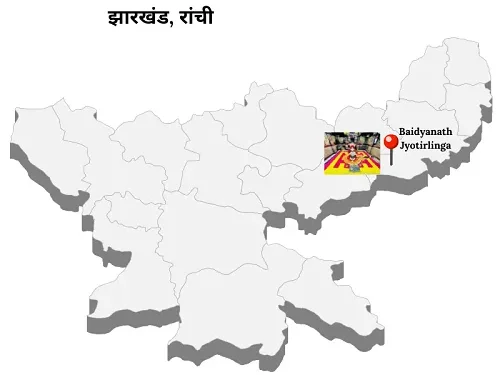
- State: Jharkhand (In Santhal Pargana region)
- District: Deoghar
- Nearest Airport: Deoghar Airport, just 9 km away
- Nearest Railway Station: Jasidih Junction, approx. 7 km away
- Distance from Delhi: 1,257 km by road
- Nearby Attractions: Trikuta Parvat, Basuki Nath temple, Satsang Ashram.
Vaidyanath or Baidyanath Jyotirlinga is the ninth Jyotirlinga among the twelve in the Deoghar district of Jharkhand. Baidyanath, also known as Baba Dham and Vaidyanath here.
The temple has great road, train, and air connectivity, making it easier for pilgrims to seek the blessings of the Jyotirlinga.
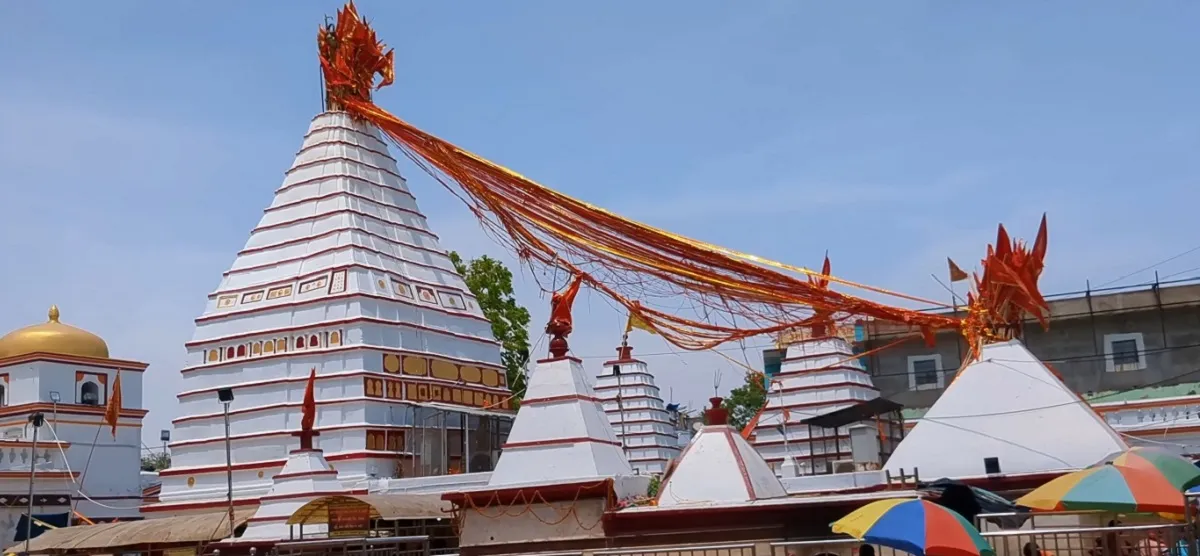
Mythological Significance
This place holds great significance as the divine site where Lord Shiva manifested as the divine Vaidya (healer) to cure the Brahmin demon Ravana, leading to its name “Baidyanath.”
Today, the temple holds great importance as the site of powerful healers and also attracts millions of devotees every year to seek blessings.
How Many Jyotirlinga are in Uttar Pradesh?
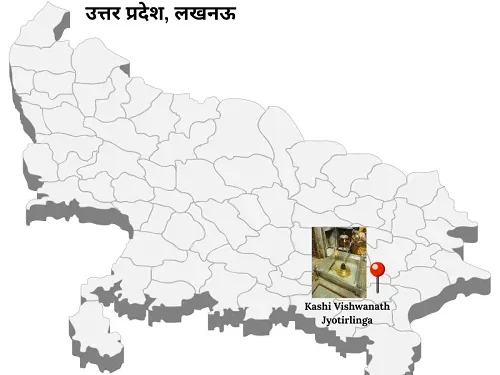
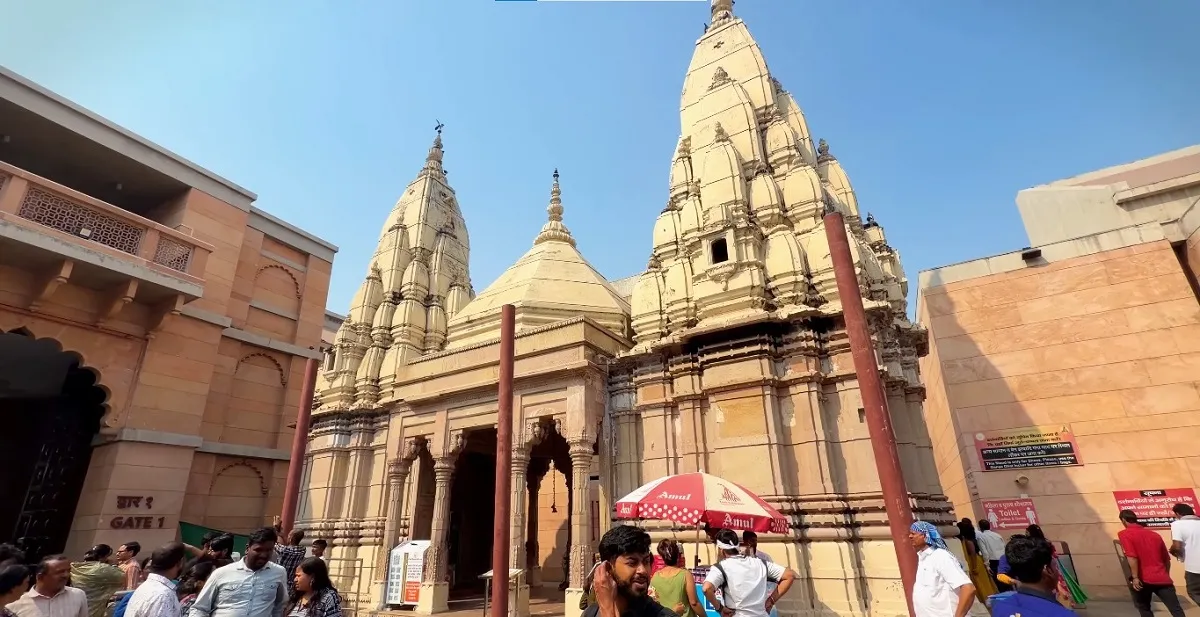
There is only one prominent Jyotirlinga in Uttar Pradesh, named the Kashi Vishwanath temple. Located in the Varanasi city of the state. Dedicated to Lord Shiva, who is worshipped here as “Lord of the Universe.”
Kashi Vishwanath Jyotirlinga
- State: Uttar Pradesh
- District: Varanasi (In Lahori tola village)
- Nearest airport: Lal Bhadur Shastri International Airport
- Nearest railway station: Varanasi Junction
- Distance from Delhi: 815 km
- Nearby Attractions: Manikarnika ghat, Nepali temple, & Sarnath
Situated on the westernmost banks of the holy Ganga River, Kashi Vishwanath is one of the most significant shrines of Lord Shiva. Located in the spiritual heart of Varanasi, it is famous for its huge complex, attracting and welcoming millions of devotees.
The temple is featuring via 15 meters gold sphere, which was donated by King Maharaja Ranjit Singh, who took his last breath at this sacred spot.
Mythological Significance
According to Hindu legends about Kashi Vishwanath Temple, it is the original royal and permanent residence of Lord Shiva. It is believed that after the dispute between Lord Vishnu and Lord Brahma who is the supreme. After resolving the dispute of supremacy, Lord Shiva manifested here as an infinite pillar of light to settle down.
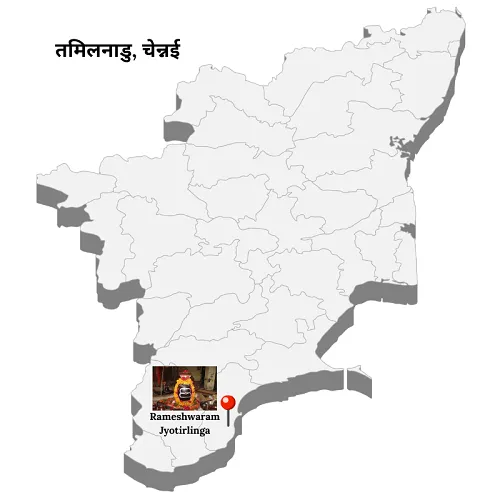
Rameshwaram Jyotirlinga, Tamil Nadu
- State: Tamil Nadu
- District: Rameshwaram Island
- Nearest Airport: Madurai International Airport (179 km away)
- Nearest Railway Station: Rameshwaram Railway Station (1 km away)
- Distance from Delhi: 2,704 km by road
- Nearby attractions: Agni Theertham, Lord Hanuman temple, Lakshmana Teertham
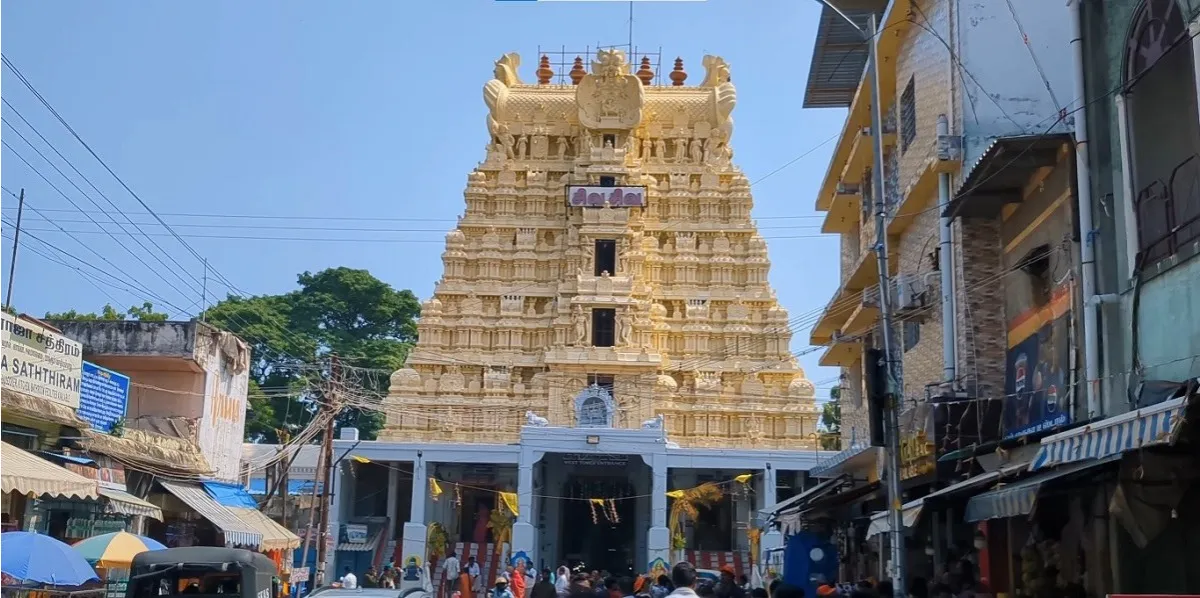
In southern India, Rameshwaram Temple, situated on Rameshwaram Island in Tamil Nadu, is a famous Jyotirlinga. It is renowned for its huge complex, featuring 22 small holy tirthams, attracting millions of devotees.
Mythological Significance
Rameshwaram or Ramanathswamy Temple is the southernmost Jyotirlinga among 12 sacred shrines. Holding significance as part of the major Char Dham pilgrimage circuit.
It is believed to be a place where Lord Rama formed the shivalinga and worshipped Lord Shiva to atone for the sins of killing the Brahmin demon Ravana.
Read More: About Rameshwaram Temple
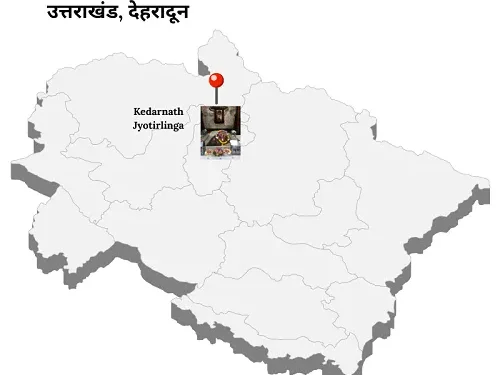
Kedarnath Jyotirlinga, Uttarakhand
- State: Uttarakhand (Garhwal region)
- District: Rudraprayag district
- Nearest Airport: Jolly Grant Airport in Dehradun, around 235 km away
- Nearest railway stations: Rishikesh Railway Station (225 km) & Haridwar Junction (240 km)
- Distance from Delhi: 470 km by road
- Nearby Attractions: Bhim Shila, Bhairavnath, Adi Shankaracharya samadhi, Retus Kund, & Vasuki tal
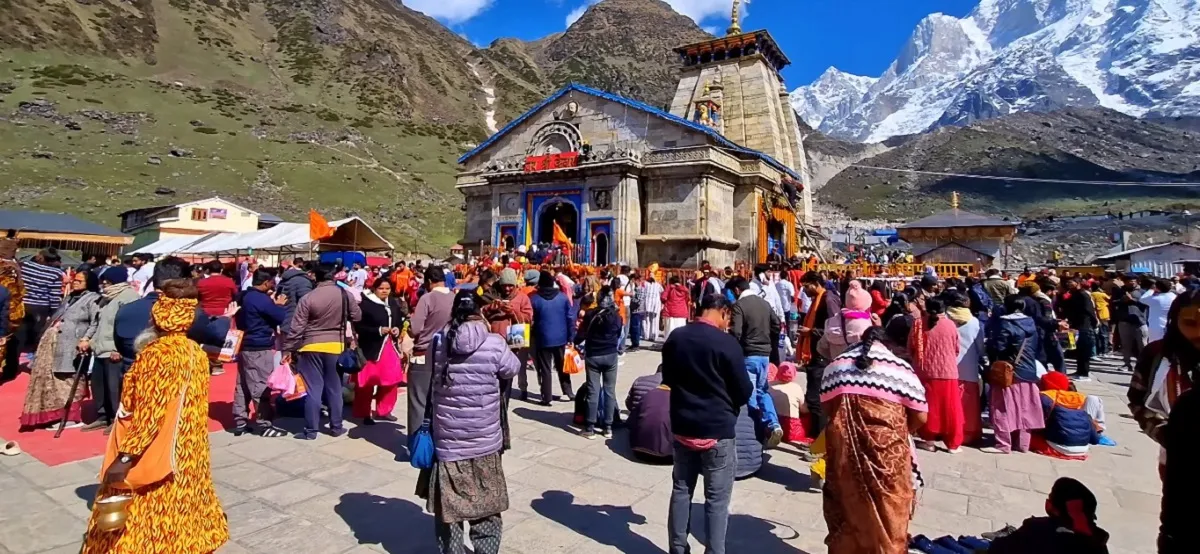
Nestled in the Garhwal Himalayas of Uttarakhand in the Rudraprayag district, Kedarnath is a revered shrine of Lord Shiva. Situated on the banks of the Mandakini River and surrounded by snow-capped peaks.
Also, it is the highest Jyotirlinga among the twelve in India and the only temple that is open only for a few months a year, from May to October, and is closed in winter due to heavy snowfall.
Significance & Story
It holds great significance for devotees as the core part of the Do Dham yatra and Panch Kedar pilgrimage. Moreover, it is believed that visiting here cleanses sins, purifies souls, and grants liberation.
The Jyotirlinga here is believed to be self-manifested, but the shape of the Jyotirlinga here is not ordinary; it is triangular, signifying the hump of a bull.
Ancient legends describe that, when the Pandavas were searching for Mahadev for the atonement of their sins. Mahadev hid in the Himalayas in the form of a bull. Bhima, the strong brother, recognised the bull and grabbed its hump.
The bull began to merge into the earth and appeared in five different body parts at various locations, one of them being Kedarnath.
How To Plan a 12 Jyotirlinga Trip?
Planning a trip to the 12 Jyotirlinga requires significant travel across the different states of India, as these shrines are spread over 8 Indian states.
The complete journey takes around 15-20 days of mixed travel by air, road, and train.
The suggested itinerary for 12 Jyotirlingas, with a cluster approach, saves older pilgrims from travel fatigue.
Phase 1 Gujarat (3-4 days)
Temple cover: Somnath & Nageshwar
Route flow: Fly or take a train to Ahmedabad or Rajkot. From either station or airport, rent a private taxi to Somnath first, then head towards Nageshwar in Dwarka. The distance between Somnath and Nageshwar is roughly 253 km, takes around 5-6 hours, and can be completed in 3-4 days.
Phase 2: Madhya Pradesh (2-3 days)
Temple cover: Mahakaleshwar & Omkareshwar
Route: From Ahmedabad, take a train or fly to Indore. From there, head on a drive to Omkareshwar and Mahakaleshwar. Both shrines are around 155 km away from each other, taking around 5-6 hours. Can be covered in 2-3 days, along with frequent stops.
Phase 3: Maharashtra (3-4 days)
Temple cover: Trimbakeshwar, Bhimashankar, & Grishneshwar
Route: Take a premium train to Pune for Bhimashankar; head in a private taxi towards Nashik to cover Trimbakeshwar, and then travel to Grishneshwar Jyotirlinga.
Phase 4: South & East India (5-6 days)
Temple cover: Mallikarjuna, Rameshwaram, Baidyanath, & Kashi Vishwanath
Route: Fly to Hyderabad, then taxi to Srisailam to visit Mallikarjuna. Then head towards Madurai airport or Rameshwaram Railway station to visit Rameshwaram Jyotirlinga.
Then, from Madurai, transfer to Deoghar airport for the Baidyanath temple and proceed toward Varanasi to cover the Kashi Vishwanath temple.
Phase 5: Final Leg North Himalaya (Kedarnath)
Temple cover: Kedarnath Temple
Route: Accessible seasonally, from May to October. Travel to Dehradun Airport or Haridwar/Rishikesh Railway Station. From there, drive towards Gaurikund and head towards the trek to reach the temple.
Then plan your return journey by train or air travel.
Special Tips for Older People
- Flight/Private Travel: They must prefer a flight journey or travel by private vehicles for a comfortable journey.
- Pony/Helicopter Service: They can opt for Pony/palki service for the Kedarnath trek or Kedarnath Helicopter service for safe travel.
- Carry Medicines: Must-carry essential medicines for basic issues and a prescription.
- Consult a doctor: Take a health advisory and complete a medical test to ensure a safe yatra.
- Avoid Solo Travel: It is a long journey; travel with family members or a group to ensure availability during any emergency.
FAQs
Which Jyotirlinga to visit first?
As per the traditional sequence, Somnath Jyotirlinga is considered the first and foremost among the 12 Jyotirlinga, located in Prabhas Patan, Gujarat.
Why is there no Shivlinga in Trimbakeshwar?
Actually, Trimbakeshwar has a Shivlinga, but it’s unique among all 12 Jyotirlingas. It’s an bowl shapped, three small-sized lingams that represent the Hindu trinity: Brahma, Vishnu & Mahesh (Shiva). Due to its submerged form, the Trimbakeshwar Shivlinga is covered by a silver or gold mask and represents the trinity of the universe.
Which are the three Jyotirlinga near Ujjain?
There are two primary Jyotirlingas near Ujjain, Madhya Pradesh. While Ujjain is home of a single Jyotirlinga named Mahakaleshwar, and other near Jyotirlinga is Omkareshwar, located in the Khandwa district of Madhya Pradesh.
Which is the smallest Jyotirlinga in India?
Grishneshwar is the smallest Jyotirlinga among the 12 Jyotirlingas in India. It is small in its physical dimension.
Which Baidyanath Jyotirlinga is original?
The original Baidyanath Jyotirlinga is the Baba Baidyanath temple in Deoghar, Jharkhand. State with the legend of the Brahmin demon Ravana mentioned in ancient Hindu scriptures.
Are women allowed to enter Jyotirlinga?
Yes, women are absolutely allowed to enter the sacred 12 Jyotirlinga of Lord Shiva in Hinduism. Every year, many womens are undertaken the sacred pilgrimage to seek the divine blessings of the deity.
How many Jyotirlingas are in Varanasi?
There is only one Jyotirlinga in Varanasi, Kashi Vishwanath Jyotirlinga (Vishveshwara), which is one of the famous Jyotirlingas among the 12 Jyotirlinga of India. Moreover, it is unique as it contains all 12 pillars of light (Jyotirlinga), one of the original shivlinga and the other 11 symbolic shrines.

Muskan is a skilled travel content writer, specializing in crafting engaging, informative, and helpful content that connects with readers. She has been writing content for over 4 years for Musafir Resort. She understands the strategies and techniques to deliver the best travel guides, destination reviews, and creative stories that showcase destinations at their best.
From the beautiful Himalayas to vibrant cities, she has crafted multiple experiences that reflect the reality and authenticity of the places. Muskan focuses on writing content that not just engages, but is valuable and helps travellers to plan a memorable experience.


Comments (23)