
About Somnath Temple
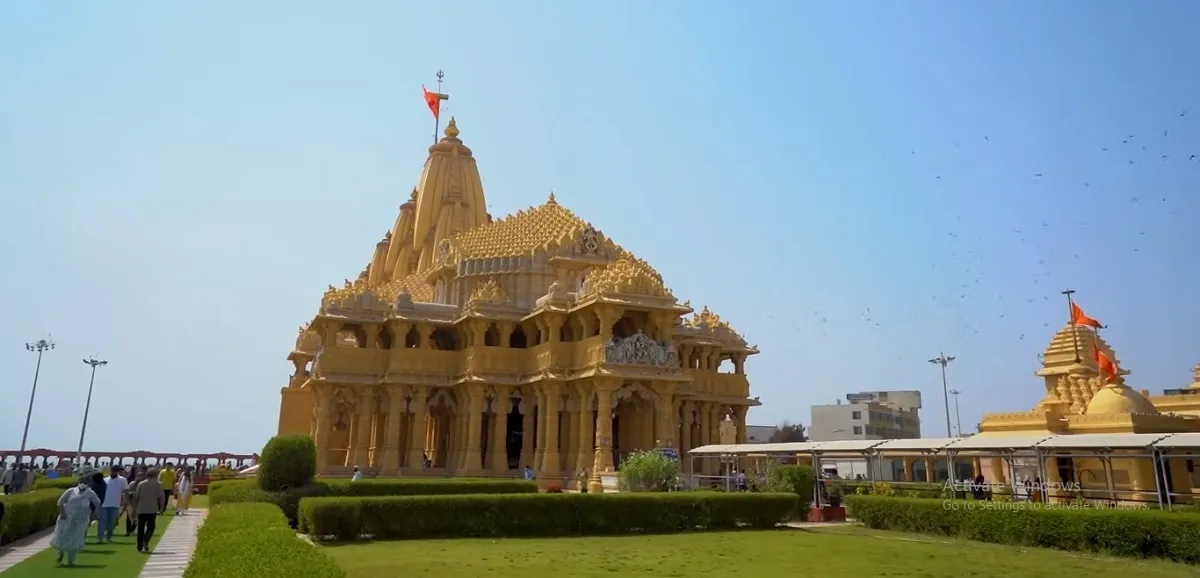
Shree Somnath Temple is the first and most prominent site among the 12 Jyotirlinga of Shiva. Located in the Gir Somnath district of Gujarat and sitting on the western coast along the Arabian Sea, the site is also known for its strategic location.
Visiting Somnath Jyotirlinga is a divine experience in itself, taking blessings and exploring the spiritual and sacred energy of this prominent site.
The experience is not limited to the temple; it also offers nearby sites like Somnath Beach, Prabhas Patan Museum, and Balika Tirth, which are truly divine. Also, another famous Jyotirlinga, Shri Nageshwar Jyotirling, is near this shrine in Dwarka, Gujarat.
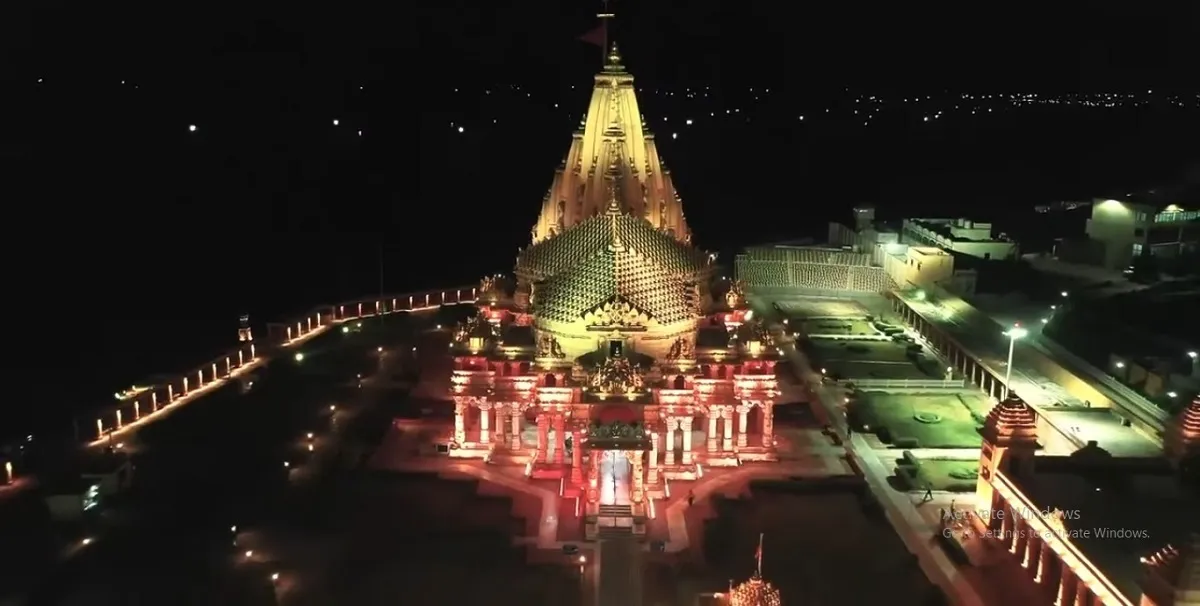
The temple hosts a light and sound show every night, attracting and loved by many visitors.
Quick information about Somnath
- State: Gujarat
- City: Veraval (near Prabhas Patan area)
- District: Gir Somnath district
- Pin code: 362268
- Highlights: 3D show & Tribeni Sangam
- Somnath Nearest Railway Station: Vairaval Junction (approx. 6 km away)
- Somnath Mandir Nearest Airports: DIU Airport (82 km) & Rajkot Airport (198 km)
- Best time to visit: October to March
- Festivals celebrate: Mahashivratri & Kartik Purnima
- Dress code: The temple trust enforces a strict and modest dress code for men (Kurta-Pajama) & women (Dhoti, salwar-kameez)
Where is Somnath Temple Located?
The Somnath temple is located in the town of Veraval, near the Prabhas Patal area of Gir Somnath District in Gujarat, in western India.
Situated on the western coast of the Arabian Sea, the temple is renowned for its geographical feature. The famous for the Triveni Sangam (a scenic confluence of Hiran, Kapila, and the mystical Saraswati rivers).
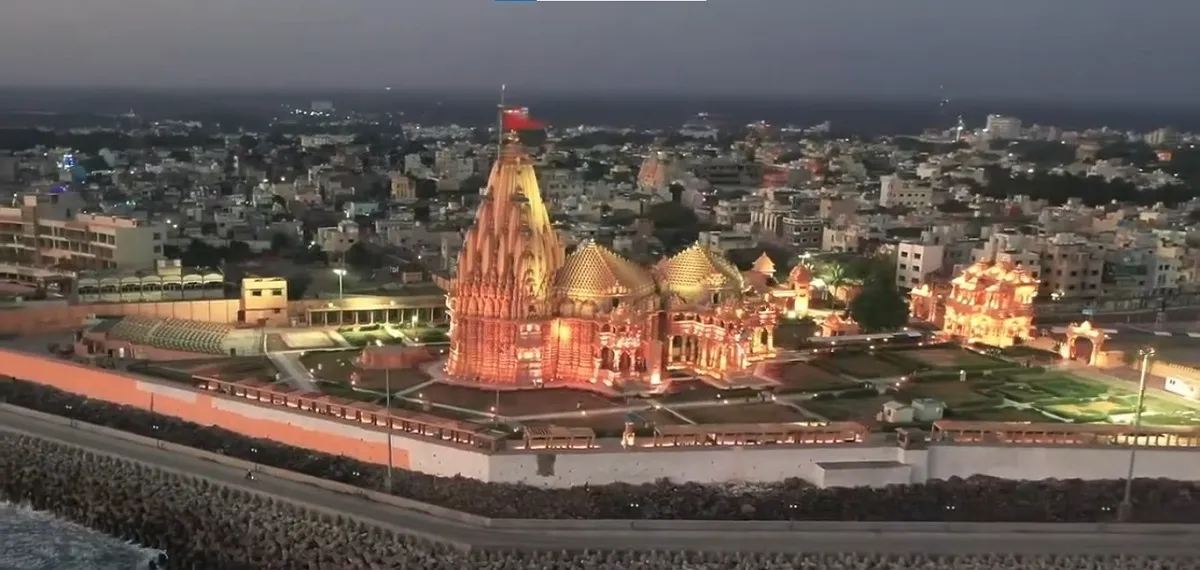
Its strategic location on a sea protection wall, an ancient pillar marked as a straight line between Somnath and Antarctica, with no land.
What is special about the Somnath temple?
The speciality about the Somnath temple lies in its significance, revered as the very first Jyotirlinga called Adi Jyotirlinga, and its legendary status as an “eternal shrine.”
Watching the Jay Somnath light show held every night, which narrates temple history and legend, is a great experience for history enthusiasts.
Visiting the Somnath Mahadev temple and exploring the local markets (cultural walk) is a healing and renewal experience.
Somnath is also very famous for its colourful Bazaars, where you can buy wooden replicas of the temple, devotional items, and traditional Gujarati handicrafts, like wall hangings and beadwork.
Why is Somnath the first Jyotirlinga?
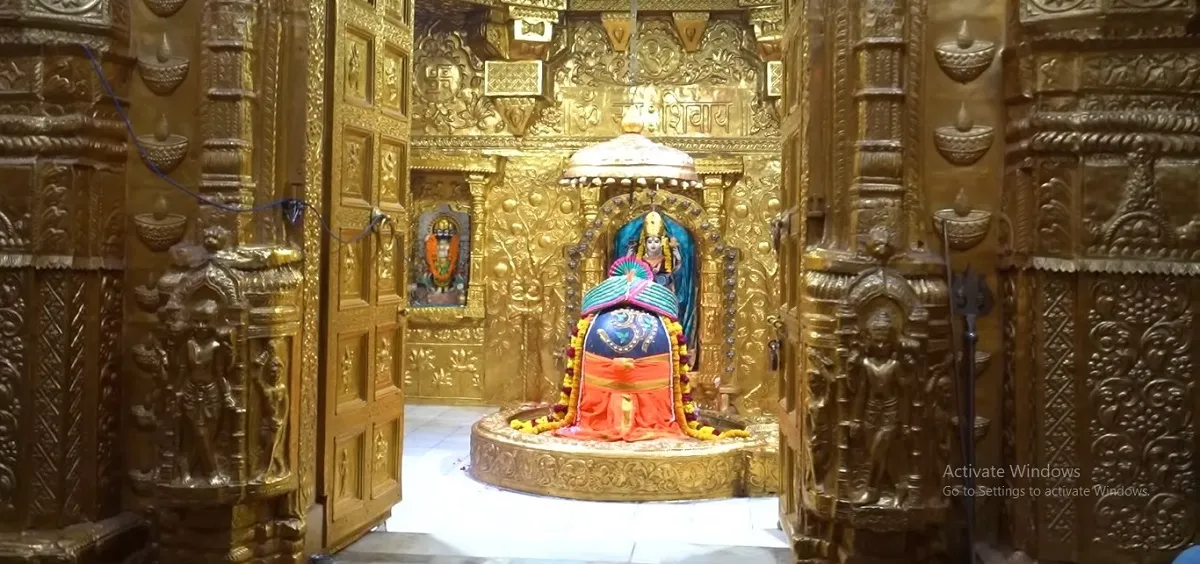
Somnath Shivling is highly revered as the first Jyotirlinga (often called Adi Jyotirlinga) among 12 cosmic shrines. Also, this Jyotirlinga comes at the top in the order of Jyotirlinga Yatra.
Ancient texts and mythology define the reason for Somnath Jyotirlinga’s supremacy as the first Jyotirlinga.
According to the legend of the Shiva Purana, Jnanasahita Khand, Lord Shiva appeared first here as an infinite column of light to free Lord Moon from the curse of losing his charm. He performed intense penance in Prabhas Kshetram, where Somnath is located.
Can we touch Somnath Jyotirlinga?
No, you can not touch the Somnath Jyotirlinga, as it is strictly restricted for regular devotees to maintain the sanctity of the site. Only Pujaris are allowed to touch and perform rituals on the Somnath Shivling.
Somnath Temple History
The Somnath temple is known as the “eternal shrine” due to its profound history, which is a blend of ancient mythology stories and several historic accounts.
According to Hindu legend, the original Somnath temple was built by the Moon God (Chandra Dev), who performed penance to Lord Shiva to be granted grace from the curse of darkness. Shiva blessed him, Chandra dev built a temple with gold in gratitude towards him.
Lately, it has been rebuilt in silver by Ravana, then with Sandalwood by Lord Krishna, and with stone by King Bhimdeva.
In its history, the Somnath temple faced destruction over 17 times, having been attacked and raided by many foreign invaders, as the region was renowned for its cultural importance and wealth.
But due to spiritual perseverance, the temple was rebuilt again by the respective Hindu rulers.
At first, the Somnath temple was attacked by Mohammad Gazani in 1095 C.E., who looted the temple and destroyed it. The Somnath temple was invaded by many Gujarat and Delhi Sultanate rulers.
Now, if we talk about its rebuilt history, the Hindu rulers King Kumarpala, Mahipal, and Rani Ahilyabai Holkar rebuilt the structure of the temple.
In the modern historical timeline, construction of the temple started on 12 November 1947 during the visit of Sardar Vallabhbhai Patel to this region, who instructed the reconstruction of the temple due to its cultural significance.
In May 1951, the former and first prime minister, Dr. Rajendra Prasad, inaugurated the temple and performed the rituals of Pran Pratistha of the sacred Shivling.
Today, the temple is taken care of by a dedicated temple committee, who managed the flow of pilgrims to this sacred site.
Is Somnath Temple made of gold?
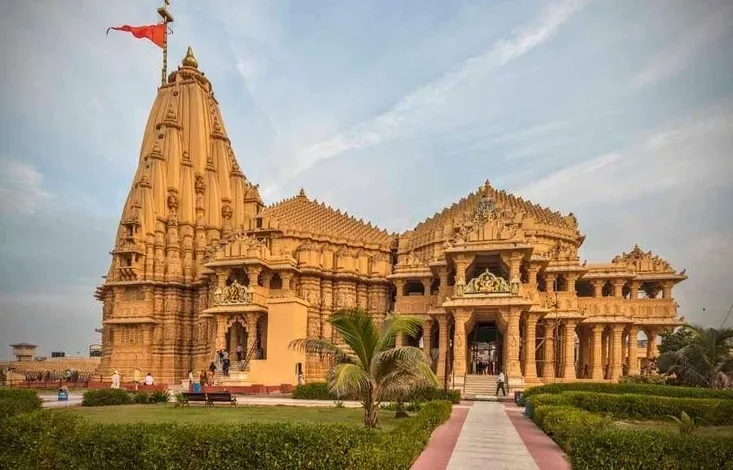
The Somnath temple is not completely made with solid gold but heavily plated with it. The outer structure of the temple is made with sandstone, resembling traditional Chalukya architecture.
While the inner structure, the main sanctum, and the spire are heavily coated with Gold, featuring 130 kg of gold in the sanctum and pillar and 150 kg of pure gold in the spire.
The mythological accounts suggest that the temple was built by the Moon God with pure gold and later built with silver by the Brahman demon Ravana.
What is the Story Behind Somnath Jyotirlinga Temple?
The Somnath temple story is linked with the legend of Chandra dev, his penance, and Lord Shiva, who appeared as a cosmic form of energy leading to the origin of Somnath Jyotirlinga.
As per the legend of the Jnanasamhita khand of Shiva Purana, this is a sacred place of Lord Chandra, who performed intense penance here.
Legend states that Chandra married 27 daughters of King Prajapati but favored only one, named Rohini. Angered by this injustice, Daksha cursed that Chandra would lose its charm and fade away.
Desperate and fearing that Chandra would come to Prabhas kshetra (Somnath) to perform penance to Lord Shiva on the recommendation of Lord Brahma. Pleased by his devotion, Shiva appeared as cosmic light and blessed him.
He cannot curse the underdone but can modify it; the moon would vanish for 15 days and wax for the next 15 days, explaining the lunar cycle.
After that, Blessed Chandra built the original Somnath with gold to honor Lord Shiva, and gave the name “Somnath,” which means lord of the Moon.
Significance & Importance of Somnath Temple
The Somnath temple holds great significance due to its spiritual and cultural resilience. The first Adi Jyotirlinga among 12 sacred shrines and its strategic location at the sacred Triveni Sangam attract thousands of devotees across India.
The eternal temple, despite being destroyed multiple times, stands as a great symbol of India’s cultural resilience. Seeking blessings at this sacred pilgrimage site helps devotees achieve salvation, making it a significant and prominent pilgrimage in India.
Somnath Temple Timings
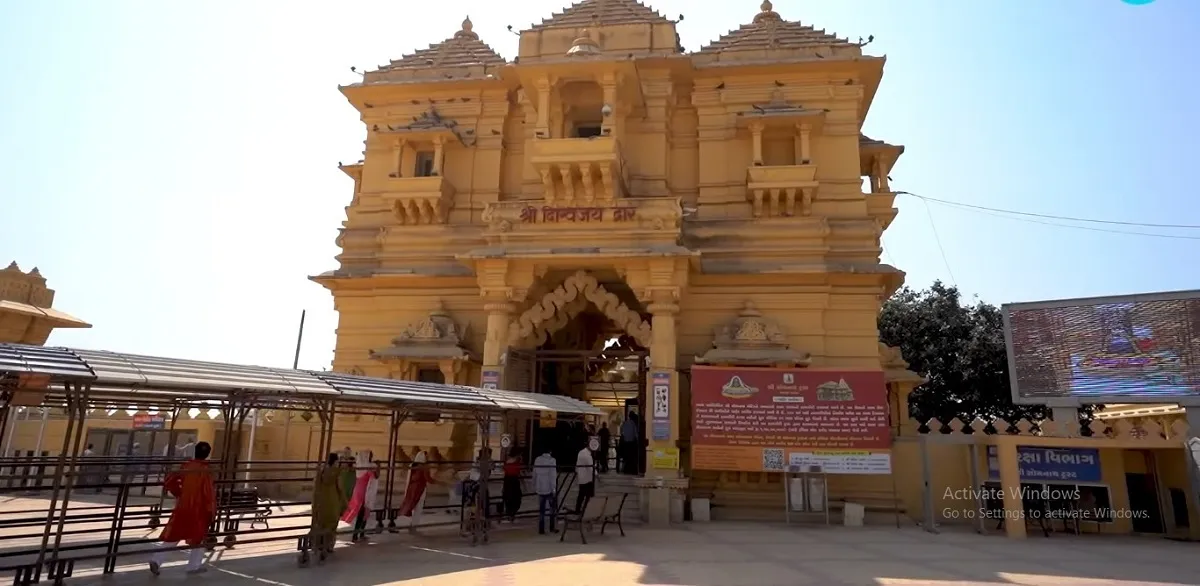
Like the many temples, the Somnath temple follows a strict schedule of regular darshan, Aarti, and Puja rituals.
Below are the Somnath temple darshan and Aarti timings:
| Event | Time |
| Temple Open: | 6:00 AM |
| Morning Aarti: | 7:00 AM |
| Darshan slot: | 6:00 AM to 12:00 PM |
| Afternoon Break (Bhog Aarti): | 12:00 PM |
| Evening Aarti: | 7:00 PM |
| Evening light show: | 7:45 PM to 8:00 PM and 8:30 PM to 8:45 PM |
| Temple close: | At 10:00 PM |
Generally, it opens from 6:00 AM to 10:00 PM for regular Darshan along with frequent breaks for morning and evening aarti, and a night light and sound show held from 8:00 PM to 9:00 PM daily.
For those who are unable to visit or get a physical Darshan, the Somnath temple committee provides a digital stream of Somnath live Darshan daily, which you can check on their portal (Somnath Live Darshan Portal).
Is there any Somnath VIP Darshan Booking Available?
No, there is no VIP Darshan booking system in Somnath. The temple trust ensures equal access to all pilgrims via general Darshan, which is completely free.
So be cautious about any travel agency or third-party agent who claims it.
While there is no VIP Darshan system, it offers online puja booking options for devotees. You can book the Somnath Puja/Vidhi ticket online via the official portal of the Somnath temple trust or offline via a counter near the temple.
Things To Do In Somnath
There are several things to do in Somnath:
- Seeking blessings at Somnath Jyotirlinga
- Attend the Somnath light and sound show, held twice a night (from 7:45 PM to 8:45 PM), narrating the temple’s history and legends.
Note: The cost of Jay Somnath light and sound show is 50 Rs. for adults and 30 Rs. for children.
- Visit nearby historic landmarks like Prabhas Patal Museum
- Walking around the seaside of Arbean sea to experience the fresh ocean breeze

Somnath Accommodation Options
Accommodation in Somnath offers a mix of premium and budget-friendly stays. There are several hotels, dharamshalas, dormitories, and beachside resorts near the temple.
Below are some popular hotels in Somnath:
- Lords Inn Somnath
- Sarovar Portico Somnath
- Shree Somnath Trust Dormitories
- Leelavati Guest House (budget-friendly option)
- Hotel Madhukta in Somnath
- Hotel Platinum Somnath
Best Time To Visit Somnath Temple
The best time to visit the Somnath temple is from October to February, the peak season for Somnath, with pleasant and cool weather and mild temperatures. Ideal for darshan and sightseeing.
While summer, from March to June, is not a good time to visit due to the heat. Also, temperatures reach up to 38 °C, and there is high humidity.
Below is a seasonal breakdown to help you to choose your best time accordingly:
Peak winter season (October to February): Attracts a huge crowd during this time due to pleasant weather and cultural vibrancy. All the festivals, Kartik Purnima, Diwali (occurs in November), and Mahashivratri (falls in February or March) are celebrated during this time.
Summer (March to June): Not ideal due to high humidity and hot climate. Suitable only for those seeking a budget trip and who want to experience fewer crowds.
Monsoon (July to August): Receives moderate rainfall, transforming landscapes and surroundings into lush greenery, and offers a serene experience. But check the accessibility and road conditions first.
Places To Visit In Somnath
Somnath itself is a prominent spiritual destination in Gujarat, but there are several sightseeing places near Somnath, which travelers can visit on a one-day trip.
Below are some of the best places to visit near Somnath in one day:
- Triveni Sangam: Triveni Sangam Somnath is a main attraction of this region, where three rivers, Hiran, Saraswati, and Kapila, meet before merging to Arbean sea. Located just 1.5 km south of the main temple, it holds significance, for taking a holy dip in it is highly auspicious before entering the temple.
- Bhalka Tirth: Another sacred spot, just 4 km from the Somnath temple, Bhalka Tirth is a significant temple of Lord Krishna. Believed to be a very sacred place, an arrow shot by a hunter hit Lord Krishna’s foot, leading to his leaving the mortal world.
- Old Somnath Temple: Also known as Ahilya Bai Temple, the old Somnath Temple is located just behind the main temple. Built by Maharani Ahilyabai in the 18th century.
- Somnath Beach: Located just behind the Somnath temple complex, it is a great spot to experience cool breezes in the evening and to witness massive sunset views.
- Panch Pandav Gufa: An underground cave side, near the temple, believed to be a place where Pandavas from the Mahabharata meditated during their exile.
How To Reach Somnath Temple?
You can reach the Somnath temple by air, train, or road. Firstly, you must travel to Veraval first, followed by a road journey to reach the temple.
By Air: Somnath doesn’t have its own airport; the nearby airports are:
- Keshod Airport: 57 km
- Diu Airport: 82 km away, operates daily flights from Mumbai and Ahmedabad
- Rajkot International Airport: A major airhead at a distance of around 198 km, and has great connectivity from major sites.
You can take a flight from any of these airports and then hire a private taxi to reach Somnath. Cab services are easily available from the airport to the Somnath temple.
By Train: Vairaval Junction and Somnath Railway stations (local station) both are the primary railheads to the site. Veraval offers great connectivity to major indian cities. Sabarmati-veraval Vande Bharat is a premium train.
If you are a Delhi traveler, then take a train to Rajkot, and then complete the rest of your journey by road.
By Road: Somnath has great road connectivity via the NH-51 route. You can travel by self-drive or via state-run buses from cities like Ahmedabad, Rajkot, and Dwarka.
Conclusion
Shri Somnath temple, the Adi First Jyotirlinga of twelve Jyotirlingas, is a great symbol of grace and has been rebuilt despite being destroyed multiple times.
Attracting millions of devotees across India, it remains an emblem of regional culture and spiritual heritage.
Dedicated to Lord Shiva, giving him the name “Somnath” means God of the moon, also famous for many nearby attractions like Triveni sangam and Patal Prabhas museum, etc., an ideal destination for family travelers.
FAQs
Which city is closest to Somnath temple?
Veraval is the closest city to the Somnath temple, just 7 km away. It serves as the primary hub for basic amenities for travelers visiting the Somnath temple.
Where to go first, Dwarka or Somnath?
Well, logistically it is recommended to go to Dwarka first, then move towards Somnath; this flow offers a smooth flow. Dwarka offers a vibrant tone, while Somnath offers a peaceful and serene experience.
Is one day enough for Somnath?
Yes, one day is enough to explore the core attractions of Somnath. If you are a traveler with limited time, you can comfortably visit places like the main Somnath temple, along with:
- Triveni Sangam
- Bhalka Tirth Temple
- Prabhas Patan Museum
- In the evening, attend Jay Somnath light and sound show
Which city is Somnath temple in?
Somnath temple is located in Veraval city of the Gir Somnath district near Prabhas Patan town, Gujarat, India. The temple sits on the western coast along the Arabian Sea and features the Triveni Sangam.
Which is the nearest railway station to Somnath?
The nearest railway station to Somnath is Veraval Junction, located just 6 km away from the main temple, and it is connected via Dwarka, Ahmedabad, and Rajkot. While Somnath Railway Station is another local station that offers connectivity within the Gujarat region.
Which is the nearest airport to Somnath?
The nearest and best functional airport to Somnath is Diu Airport, roughly around 82 km away having regular flights from cities like Mumbai and Ahmedabad. While Rajkot International Airport is another prominent airport, roughly around 200 kms have wider connectivity across India.

Partiksha is a dedicated travel content writer with over 5 years of experience in exploring various destinations in India. From mountains, beaches, treks, to spiritual sites, she believes in sharing experiences through creative storytelling, publishing travel guides, and engaging blogs.
She holds the technique to embrace cultures, stories, mythologies, and various experiences to engage with travellers. With an eye for aesthetics, Partiksha has crafted content that motivates travellers to explore beyond the ordinary itineraries. She doesn’t just write content, but makes it relate to the audience and helps them find what they are looking for.
Her expertise is not limited to writing content, but she also does travel blogging, destination reviews, SEO-friendly travel writing, and creative storytelling that reflects both value and authenticity. She believes that every travel destination has a story worth sharing, which helps to connect people with a place. To make your every visit memorable, she continues to do it through her expertise.



Comments (2)