
Introduction
In Uttarakhand, Lord Shiva is a part of the daily life of local villagers. From local temples to divine rituals, people do not just worship him, but they live with his presence. The famous Panch Kedar Temples mark solid proof of his presence.
The sacred 5 Kedar in India, dedicated to Lord Shiva, holds immense spiritual significance among devotees and pilgrims.
Embarking on the revered Panch Kedar Yatra in Uttarakhand offers a perfect blend of divinity, adventure, and breathtaking beauty, attracting thousands of pilgrims, trekkers, and peace seekers.
But it requires proper planning and preparation, which is why we provide the Kedarnath Trek Package and the Tungnath Temple Trek Package for a safe trek and spiritual experience.
What is Panch Kedar?
Panch Kedar is a pilgrimage including the five temples of Lord Shiva, each dedicated to a different part of his body, in various locations in the Garhwal region of Uttarakhand.
The “Panch Kedar” name means the “five abodes of Lord Shiva”. The word “Panch Kedar” is derived from the Sanskrit words: “Panch” means five, and “Kedar” is the name of Lord Shiva, referring to the five sacred Abodes of Lord Shiva, including:
- Kedarnath Temple: The first & most important, houses the hump.
- Tungnath Mahadev: The highest Shiva temple dedicated to arms (forelimbs).
- Rudranath Temple: Strenuous & Forest shrine dedicated to the face.
- Madhyamaheshwar Temple: Peaceful and calm, where the middle part (nabhi) is worshipped.
- Kalpeshwar Mahadev: The easiest to access, dedicated to the matted hair (Jata).
Where is Panch Kedar Located?
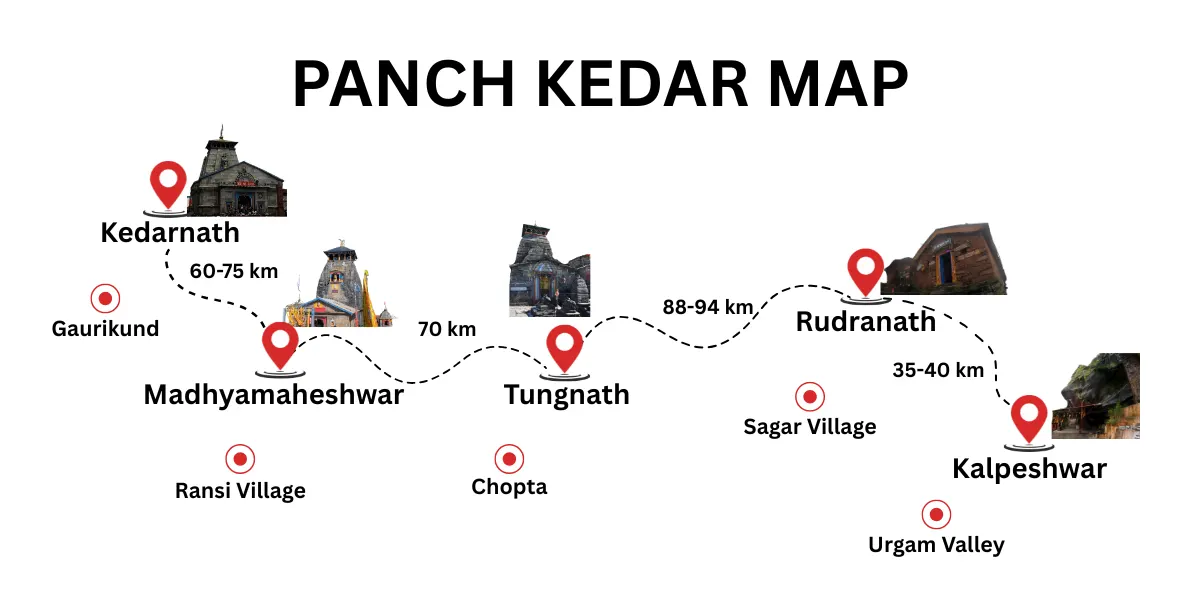
Panch Kedar Name And Location
| Temple Name | Location | Altitude (Height) | Body Part |
| Kedarnath | Rudraprayag Uttarakhand | 3,583 meters (11,755 feet) | Hump |
| Madhyamaheshwar | Rudraprayag, Uttarakhand | 3,497 meters (11,470 feet) | Navel (Stomach) |
| Tungnath | Rudraprayag, Uttarakhand | 3,680 meters (12,073 feet) | Arms (For limbs) |
| Rudranath | Chamoli, Uttarakhand | 3,600 meters (11,800 feet) | Face (Head) |
| Kalpeshwar | Chamoli, Uttarakhand | 2,200 meters (7,200 feet) | Jata (Hair) |
What is the story of Panch Kedar?
The story of the 5 Kedar temples is linked to the legends of the Pandavas in the Mahabharata, which led to the origin of this circuit.
According to Hindu legend, the Pandavas were seeking Lord Shiva’s forgiveness for the sins of killing their kinsman’s brother during the Kurukshetra war. But Lord Shiva was not ready to forgive them easily, so he took the form of Nandi (bull) to evade them and hide in the Himalayas.
One of them, Bhima, recognised him as a bull and tried to catch him, but he vanished into the earth and later appeared at five different locations as five distinct parts.
Pleased by the determination of the Pandavas, Lord Shiva forgave them. The Pandavas constructed the five temples at the exact locations where they appeared, now collectively known as the Panch Kedar Temples.
Significance of Panch Kedar Yatra
According to local beliefs, travelling the entire rugged circuit absolves the soul of Karmic debts and leads towards the path of self-discovery and inner peace.
All five are deeply tied to Hindu mythology and spiritual beliefs; they were built by the Pandavas, who were atoning for their sins after the Mahabharata war, to Lord Shiva, who took the form of a bull and dived into the earth and later appeared at five different locations and represent the distinct parts of Lord Shiva’s body.
Beyond their spiritual significance, these sites are known for their stunning Himalayan tranquillity, surrounded by lush valleys and meadows, creating a unique mix of nature and divinity. The journey also teaches the lifetime lessons of patience, endurance, and faith.
Panch Kedar Trek has become one of the most spiritual journeys in the Himalayas; unlike many pilgrimages, it is more physically demanding and tests your faith and patience.
List of Panch Kedar in Uttarakhand
Kedarnath: Pratham Kedar
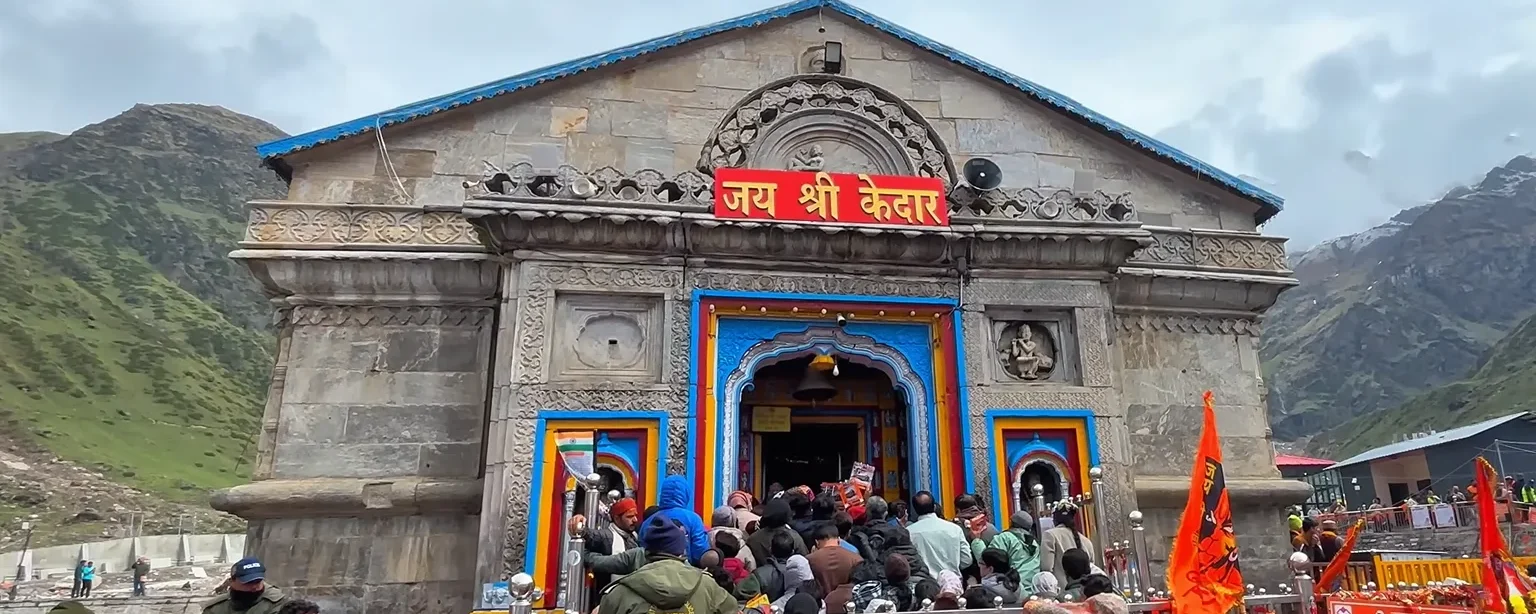
- Location: Rudraprayag district, Uttarakhand
- Height: 11,755 feet (3,583 meters)
- Body Part: Hump of the bull
- Permit: Kedarnath Registration Mandatory to access the shrine
- Highlights: Retus Kund, Bhim Shila, Bhairavnath Temple, and Adi Shankaracharya Samadhi
- Trek Distance: 16 km trek from Gaurikund
- Trek Difficulty: Moderate to Challenging
- Route from Haridwar: Haridwar → Rishikesh → Devprayag → Rudraprayag → Guptkashi → Sonprayag → Gaurikund → Kedarnath
Located in the Rudraprayag district of Uttarakhand, Kedarnath Dham is one of the most prominent of the 5 Kedars and represents the image of the bull. Kedarnath is generally considered to be visited first on the Panch Kedar Yatra.
Situated on the banks of the Mandakini River at an altitude of 11,755 feet above sea level, the site holds significance as one of the Chota Char Dham circuit and the 12 Jyotirlinga in India, surrounded by snow-capped peaks that offer stunning views.
It is the very first place where the hump of the bull (a form of lord shiva) appeared. Now, pilgrims visit here to seek the blessings of the hump-shaped shrine by a 16 km Kedarnath trek from Gaurikund, which is considered moderately challenging.
Note: Check out our Delhi to Kedarnath package cost and details for a comfortable and smooth journey to Kedarnath, the Pratham Kedar.
Madhyamaheshwar: The Second & Most Highest Kedar
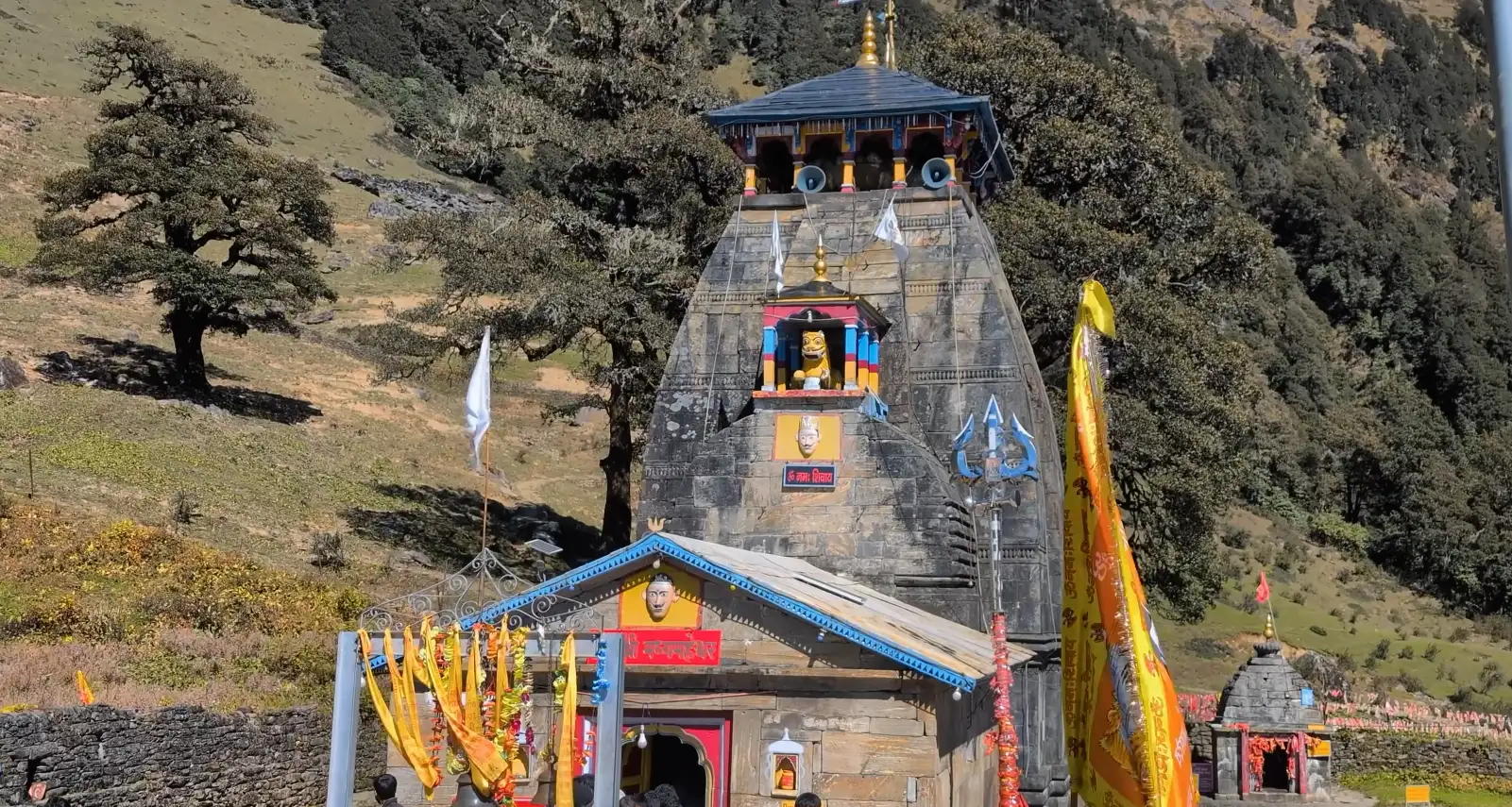
- Location: Monsoona village of Rudraprayag district within the Garhwal Himalayas
- Height: 3,497 meters (11,470 feet)
- Body Part: Navel (Stomach)
- Trek Distance: 16-18 km trek from Ransi village
- Trek Difficulty: Moderate to Difficult
- Permit: No official permit required, but a forest entry permit is mandatory to trek in the Kedarnath Wildlife Sanctuary
- Highlights: A serene atmosphere; close-up views of Chakhamba peaks
- Route from Haridwar: Haridwar → Rishikesh → Devprayag → Srinagar → Rudraprayag → Ukhimath → Ransi Village → Madhyamaheshwar
The second in the series, located in the Mansoona village of the Rudraprayag district of Uttarakhand, is Madhyamaheshwar or Madhmaheswar Temple. It is the second sacred site where the Navel/Stomach of Lord Shiva, in the form of a bull, is enshrined.
Surrounded by the snowy peaks and lush green meadows, the shrine is part of the Kedarnath Wildlife Sanctuary. Famous for its spiritual serenity and views of the Chaukhamba peaks. It requires a moderately difficult 16-18 km trek from the Ransi Village.
Tungnath Temple: Tritya Kedar
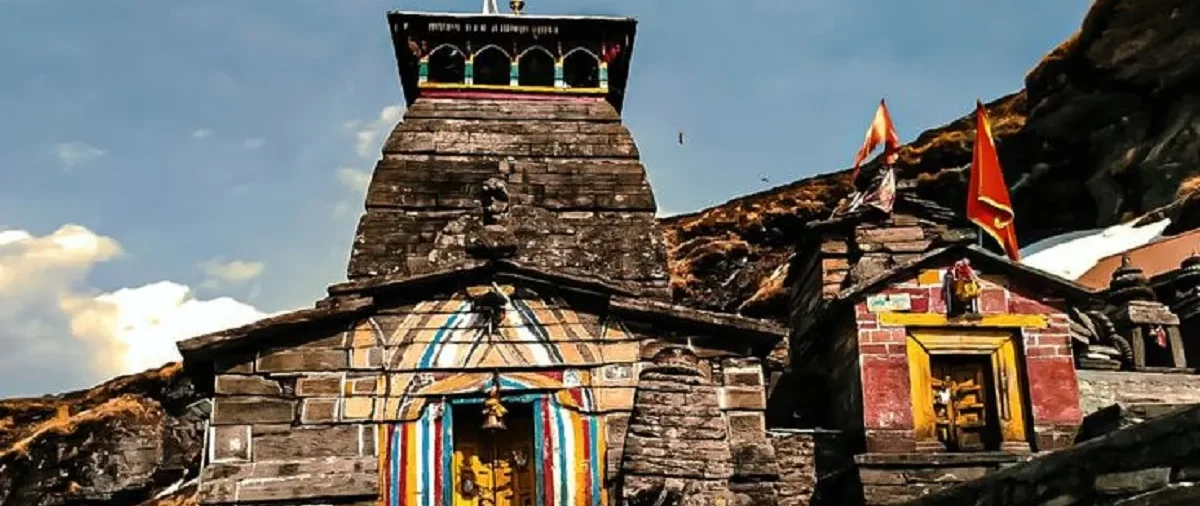
- Location: Rudraprayag district, Uttarakhand
- Height: 3,680 meters (12,073 feet)
- Body Part: Arms (forelimbs)
- Trek Distance: 3.5 km trek from Chopta Bugyal
- Trek Difficulty: Easy
- Permit: Not required
- Highlights: Rich Flora and Fauna of Chopta Valley and breathtaking views of Chandrashilla peak
- Route from Haridwar: Haridwar → Rishikesh → Devprayag → Rudraprayag → Sari Village → Chopta → Tungnath
Tungnath Mahadev is the third and highest temple in Panch Kedar and across the world, where the arms (forelimbs) of the bull appear. The temple is at an altitude of 3,680 meters in the Rudraprayag district of Uttarakhand.
This temple is often known as the third Kedar, as it comes third in the yatra. Also, it requires the shortest trek of 3.5 km from Chopta Village, widely famous for its lush green meadows and rhododendron forests.
Rudranath: The Fourth Kedar Temple
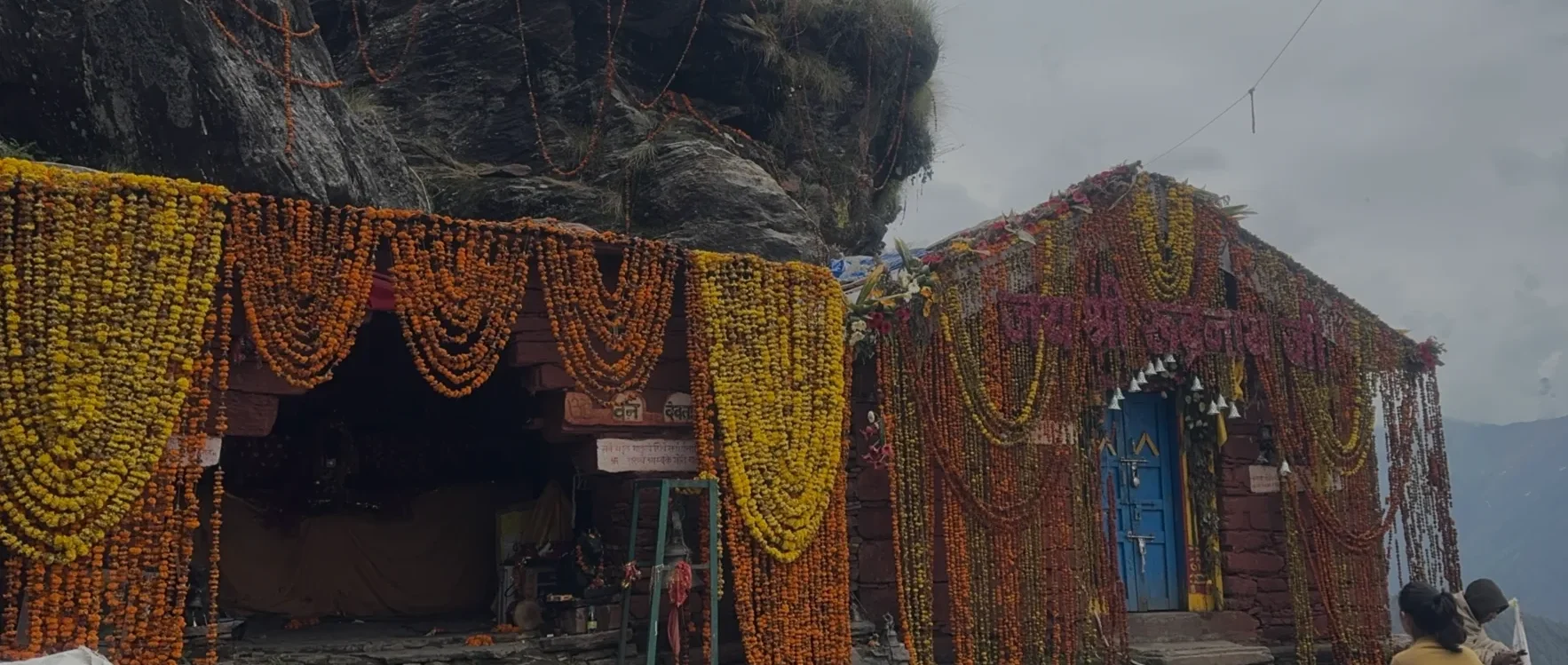
- Location: Chamoli district, Uttarakhand
- Height: 3,600 meters (11,800 feet)
- Body Part: Face
- Trek Distance: 20 km trek via Sagar village
- Trek Difficulty: Toughest
- Permit: Registration is not required, but a forest permit is mandatory from the nearest checkpoint
- Highlights: Views of the Rudraganga River flowing near the temple, the rhododendron forest, and the lush bugyal
- Route from Haridwar: Haridwar → Devprayag → Rudraprayag → Karnaprayag → Chamoli → Gopeshwar → Sagar Village → Rudranath
The fourth temple is located in the Chamoli district of Uttarakhand at an altitude of 3,600 meters above sea level. The Rudranath Temple trek is the toughest among the Panch Kedar Trek due to its strenuous 20 km trek from Sagar village.
This temple represents the Mukha (face) of Lord Shiva and is famous for aarti. The trek is challenging and known for its long walking trails, peaceful surroundings, and high-altitude passes such as Panyar and Lyuti Bugyal.
Kalpeshwar: Pancham (Fifth) Kedar
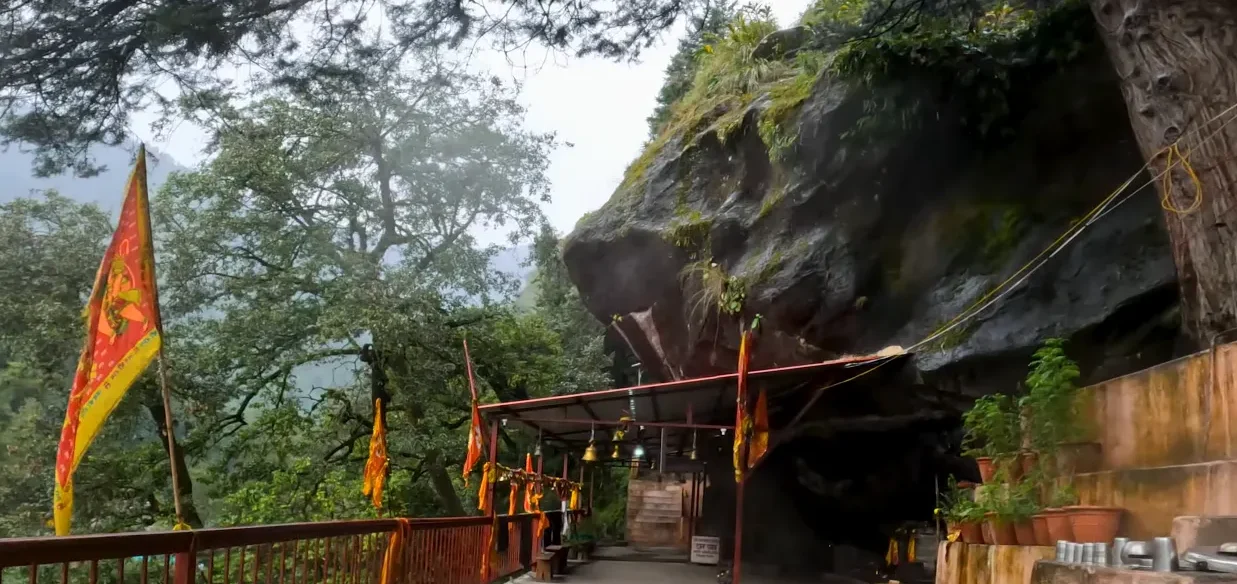
- Location: Chamoli district, Uttarakhand
- Height: 2,200 meters (7,200 feet)
- Body Part: Jata (Hair)
- Accessibility: A short walk from Urgam village
- Permit: Not required
- Highlights: Apple orchards, fields, and views of the Kalp Ganga river and peaks
- Route from Haridwar: Haridwar → Rishikesh → Devprayag → Rudraprayag → Helang → Urgam Village → Kalpeshwar
Kalpeshwar Mahadev is the easiest and only temple among the Panch Kedar that remains open all year round. Located in the Urgam valley of the Chamoli district, Uttarakhand, at an altitude of 2,200 meters above sea level.
It enshrines the matted hair (Jata) of Lord Shiva, earning the name Jatadhar/Jateshwar, and is the final destination of the sacred 5 Kedar yatra, where the yatra is completed in a sequence.
Panch Kedar Trek Difficulty & Distance
| Temple Name | Altitude (Height) | Trek Base Point | Trek Distance (one-way) | Trek Difficulty |
| Kedarnath | 3,583 meters (11,755 feet) | Gaurikund | 16 km | Moderate to Challenging |
| Madhyamaheshwar | 3,497 meters (11,470 feet) | Ransi Village | Approx. 18 km | Moderate to Difficult |
| Tungnath | 3,680 meters (12,073 feet) | Chopta Village | 3.5 km | Easy to Moderate |
| Rudranath | 3,600 meters (11,800 feet) | Sagar Village | 20 km | Toughest |
| Kalpeshwar | 2,200 meters (7,200 feet) | Helang/Urgam Valley | Short walk from base point | Easy |
Panch Kedar Trek Route Map
The Panch Kedar route map consists of road drives and trekking trails. It generally starts from Haridwar/Rishikesh and then moves towards the five sacred temples of Lord Shiva.
Haridwar/Rishikesh to Kedarnath
The journey to the Panch Kedar circuit starts from Haridwar. Firstly, drive to Gaurikund; then head on a trek to the Kedarnath temple.
- Route: Haridwar/Rishikesh → Devprayag → Rudraprayag → Gaurikund → Kedarnath
- Distance: 230 km drive & 16 km trek
Kedarnath to Madhyamaheshwar
After Kedarnath darshan, trek down to Gaurikund. From there, drive to Ransi village, the base for Madhyamaheshwar.
- Route: Kedarnath → Gaurikund → Ransi village → Madhyamaheshwar
- Distance: 70 km drive & 16-18 km trek
Madhyamaheshwar to Tungnath
Descend to Ransi village, drive to Chopa. From there heads on a trek to the Tungnath temple.
- Route: Madhamaheshwar → trek down Ransi village → drive to Chopta → trek to Tungnath
- Distance: 75 km drive & 3.5 km trek
Tungnath to Rudranath
After getting darshan in Tungnath, return to Chopta and drive to Sagar village, base for the Rudranath temple trek.
- Route: Tungnath → Chopta → Sagar village → Rudranath
- Distance: 35 km drive + 20-22 km
Rudranath to Kalpeshwar
Complete darshan in Rudranath temple, descend to Ransi and drive to Urgam village. From there, hike to Kalpeshwar. Get darshan, offer prayer, and feel the divine energy of the site.
- Route: Rudranath → Sagar village → Urgam village → Kalpeshwar
- Distance: 58 km drive + 1 km trek
Panch Kedar Opening Date 2026
The opening and closing dates of the 5 Kedar temples are seasonal decisions made by the Badri-Kedar temple committee based on astrological calculations and accessibility reasons.
For the 2026 pilgrimage season, 5 Kedar temple opening dates were announced; major shrines like Kedarnath opened on 22 April 2026 (announced on Mahashivratri), while other temples, Madhyamaheswar, Tungnath, and Rudranath, opened in late May (announced on Baishakhi at their winter abodes). Kalpeshwar remains open all year round.
Panch Kedar opening and closing dates for 2026 are:
| Temple | Opening date | Closing date (Tentative) |
| Kedarnath | 22 April 2026 | 11 November (on Bhai Dooj) |
| Madhyamaheshwar | 21 May 2026 | 20 November 2026 |
| Tungnath | 22 April 2026 | 14 November 2026 |
| Rudranath | 18 May 2026 | 3 November 2026 |
| Kalpeshwar | Open all year | — |
Note: Closing dates are tentative and generally announced on the occasion of Dussehra (which occurs in October).
Best Time To Visit Panch Kedar Temples
For pilgrims visiting Panch Kedar Shrines, must know about the best time to visit Panch Kedar, as the journey passes through valleys, high altitudes, and uncertain weather conditions.
Generally, the temples get closed during the winter, around late November, due to heavy snowfall and bad weather conditions, making the temples inaccessible. But the Kalpeshwar Mahadev Temple remains open all year round.
Ideal months to visit
- May to June (summer season): The ideal time to visit is May to June, as the weather is good with temperatures ranging from 10°C to 20°C, offering great accessibility and visibility of the peaks. All temples open at this time after their winter closure.
- September to October (Autumn season): Another good time to visit is after the monsoon, when the weather becomes pleasant again with temperatures ranging between 5°C and 15°C. Trekking trails offer stunning visibility of the surroundings.
Time to Avoid
- Monsoon (July to August): The worst time is the monsoon, because of heavy rainfall, leading to landslides and flash floods that make the trails slippery and travel difficult during this time. So avoid this period.
- Winter (November to April): During the winter, all 5 Kedar temples except Kalpeshwar are closed due to harsh weather and heavy snowfall, which makes the region inaccessible.
How To Reach Panch Kedar in Uttarakhand
Reaching the 5 Kedar temples requires a road journey to nearby base camps and trekking to the final destination. There is no direct connectivity to the shrines, and the journey passes through the scenic valleys and meadows.
Pilgrims must reach the base camps to start the trek to reach the temples.
Connectivity of Nearest Airport & Railheads
- By Air: Jolly Grant Airport in Dehradun is the nearest airport and has great connectivity from major cities in India. From the airport, head out on a road journey to the base point.
- By Train: Take a train to Haridwar and Rishikesh, the nearest railheads. From either of these stations, continue by road till the trek base, then complete the trek to reach the shrine.
- By Road: From cities like Haridwar, Rishikesh, and Dehradun, hire a private taxi or board a local bus to the major towns like Sonprayag, Chopta, Gopeswar, and Joshimath. Take a shuttle service to reach the trekking base.
Traditional route in sequence:
Kedarnath (Via Gaurikund) → Tungnath (Via Chopta) → Madhyamaheshwar (via Ransi village) → Rudranath (via Sagar village) → Kalpeshwar (via Urgam valley)
Travel Tips for Panch Kedar Yatra
- Keep buffer days: Plan at least 10-12 days for the complete journey and keep one extra day for weather delays.
- Check weather & road: Weather changes like mood swings in the Himalayas, so be aware of them.
- Connectivity: Networks are weak at high altitude, so inform your family about your travel plans. JIO & BSNL work better.
- Carry cash: Cash is king in remote areas, as ATMs are limited, so carry sufficient cash for your trip.
- Prepare physically & mentally: The 5 Kedar Yatra can test your patience and strength, so prepare well in advance.
- Book stays in Advance: Stays are limited in this region, so book them in advance, especially for peak season travel.
Accommodation & Food Options During Yatra
Accommodation during the 5 Kedar yatra is simple due to the remote Himalayan regions. It primarily consists of government rest houses, private hotels, and campsites (tent stay) along the entire route.
Key accommodations are:
Hotels & homestays near base points. Camps and lodges along the trekking routes.
Food options: Food is simple, local meals at local dhabhas, restaurants, and in-site dining hotels. Food stalls and tea stalls along the trek routes.
Conclusion
The sacred journey to the Panch Kedar temples is a path of devotion, faith, self-discovery, and spiritual awakening. The legends linked to the Mahabharata and the divine presence of Lord Shiva make the 5 Kedar in Uttarakhand attract millions of devotees and trekkers.
Moreover, each temple of the circuit has its own story and significance. The silent mountain trails and scenic Himalayan landscapes provide a life-changing experience. You will definitely feel glad when you stand by these shrines.
FAQs
In which order should I visit Panch Kedar?
Since there is no fixed order to visit Panch Kedar, for safety and convenience, the sacred journey towards the 5 Kedar temple starts from Hardwar, followed by a visit in sequence to:
- Kedarnath (Via Gaurikund)
- Tungnath (via Chopta)
- Madhyamaheshwar (via Helang)
- Rudranath (via Ransi village)
- Kalpeshwar (via Urgam)
Which is the toughest trek in Panch Kedar?
The toughest trek in Panch Kedar is the Rudranath Temple Trek due to a long distance of around 20 km, uneven terrain, high altitude, and steep climbs, requiring good physical fitness and stamina. It takes around 2 days to complete.
Which is the highest temple in Panch Kedar?
Tungnath Temple is the highest temple in Panch Kedar and the highest Shiva Temple in the world. Perched at a high altitude of 12,073 feet above sea level on the Chandranath Parvat.
Which Panch Kedar is open all year?
Kalpeshwar is the only temple among Panch Kedar that remains open all year round, due to its accessible location at a lower altitude than the other four temples.
How many days are required for Panch Kedar?
Generally, a 10-12 day trip plan is required for the Panch Kedar journey to cover all five shrines (Kedarnath, Madhyamaheshwar, Tungnath, Rudranath, and Kalpeshwar) comfortably and safely, as the journey requires travelling over 1,600 km and trekking to reach the shrines.
Is it safe to trek to Panch Kedar?
Yes, with good physical health, stamina, strong willpower, and careful route planning, the journey becomes absolutely safe. Also, proper preparation and planning are a must for a safe trek.
Which is higher, Kedarnath or Tungnath?
Tungnath is the highest Kedar among the Panch Kedar Temples, sitting at an altitude of 12,073 feet above sea level, while Kedarnath is situated at 11,755 feet (3,583 meters) above sea level.
Which Panch Kedar to visit first?
In the traditional pilgrimage route, Kedarnath is the first on the list of Panch Kedar yatra. The traditional Panch Kedar serial-wise route is: Kedarnath → Madhmaheshwar → Tungnath → Rudranath → Kalpeshwar
What is the shortest trek in Panch Kedar?
Tungnath has a very short trek, around 3.5 km from Chopta Village, to reach the Tungnath temple, while Kalpeshwar is another with the easiest access, a short shuttle walk to reach the shrine.
Are there accommodations in Panch Kedar?
Yes, accommodation is available along the Panch Kedar route, with basic facilities, such as hotels, homestays, campsites, and GMVN guest houses; it requires prior booking due to limited availability.

Partiksha is a dedicated travel content writer with over 5 years of experience in exploring various destinations in India. From mountains, beaches, treks, to spiritual sites, she believes in sharing experiences through creative storytelling, publishing travel guides, and engaging blogs.
She holds the technique to embrace cultures, stories, mythologies, and various experiences to engage with travellers. With an eye for aesthetics, Partiksha has crafted content that motivates travellers to explore beyond the ordinary itineraries. She doesn’t just write content, but makes it relate to the audience and helps them find what they are looking for.
Her expertise is not limited to writing content, but she also does travel blogging, destination reviews, SEO-friendly travel writing, and creative storytelling that reflects both value and authenticity. She believes that every travel destination has a story worth sharing, which helps to connect people with a place. To make your every visit memorable, she continues to do it through her expertise.



Comments (22)