
Introduction
Nestled in the towering peaks of the Garhwal Himalayas, Badrinath Temple is a divine shrine of Lord Vishnu. Situated at an altitude of 10,279 feet (3,133 meters) above sea level in the Chamoli district of Uttarakhand.
Every year, the site attracts millions of devotees across India due to its immense spiritual importance as a part of Char Dham and Do Dham Yatra, but here is one of the primary considerations for many travellers alike: What is the best time to visit Badrinath Temple? How is the Badrinath weather and temperature? When is the temple open? Is it safe to visit Badrinath? And many more.
That’s why I have prepared this ultimate travel guide on the best time to go Badrinath Temple, along with a weather and temperature overview and practical travel tips for safe trip planning.
What Is The Best Time To Visit Badrinath?
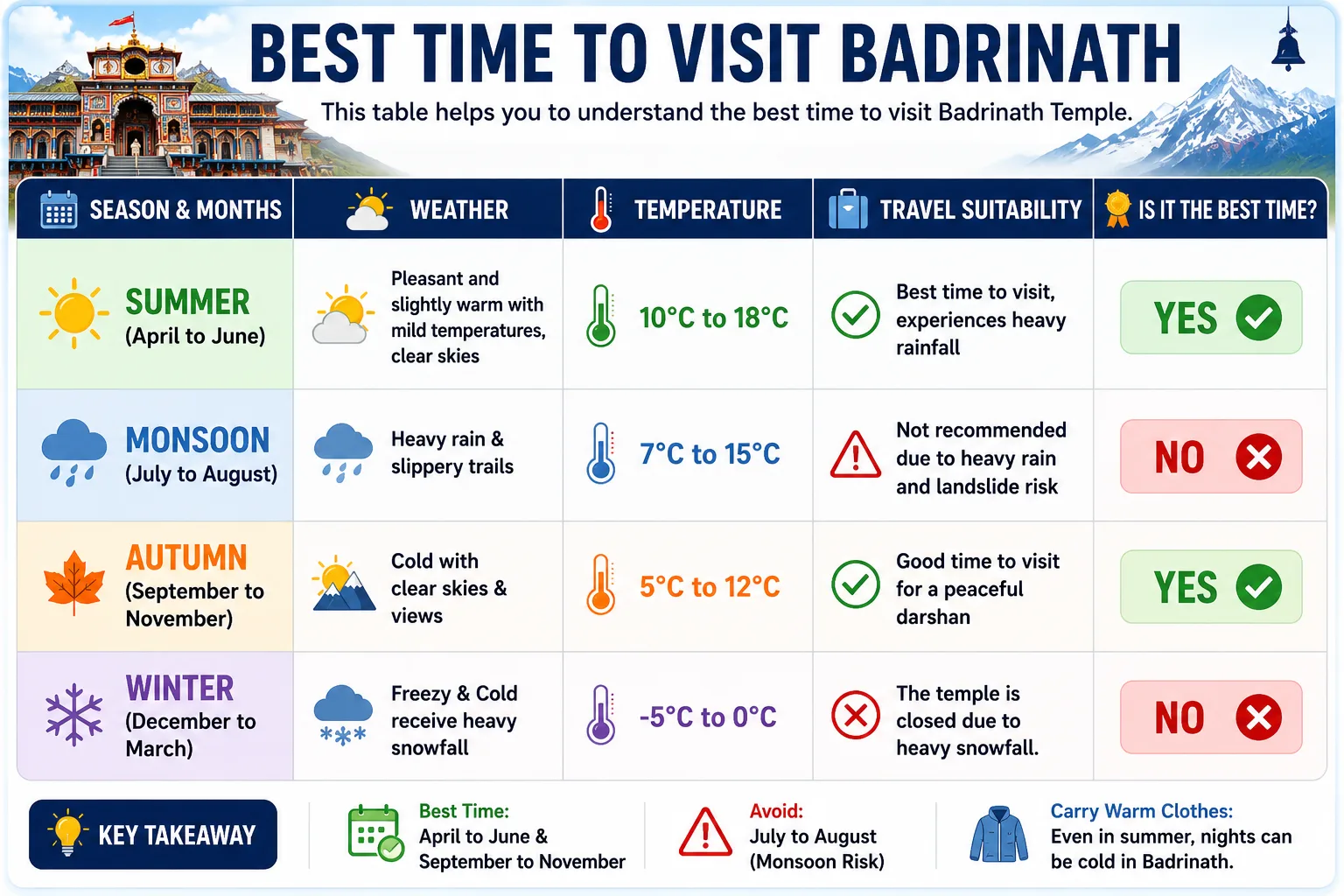
The best time to visit Badrinath is from May to June in summer for a pleasant and pleasurable experience, and from September to October in Autumn for a serene darshan experience.
These periods are excellent times to visit Badrinath, which offers stable weather, clear skies, and good accessibility, making it ideal for pilgrimage and sightseeing.
Overview of The Best Time To Go Badrinath
This table helps you to understand the best time to visit Badrinath Temple:
Is Badrinath crowded now?
Yes, Badrinath is generally crowded in the peak summer season, from late April to Mid-June, especially in May. Due to the huge number of visitors, this period may lead to long waiting hours in Darshan queues, heavy traffic on routes, and high demand for accommodation.
But in this situation, Badrinath VIP Darshan tickets truly become a blessing for devotees, especially for senior citizens.
Why is choosing the best time to visit Badrinath important?
Choosing the best time to go Badrinath is an important consideration before planning the trip due to safety and accessibility reasons.
- Badrinath Accessibility: Badrinath is a seasonal site that is accessible only for a few months (from late April/May to October) and remains closed in winter (from November to December).
- Safety reasons: During the monsoon, the region experiences heavy rainfall, which makes travel risky in the mountain region.
- Weather Fluctuation & Logistics: The weather in this region changes rapidly, and the limited infrastructure of Badrinath also makes choosing the right time to visit important.
Badrinath Weather & Temperature By Season
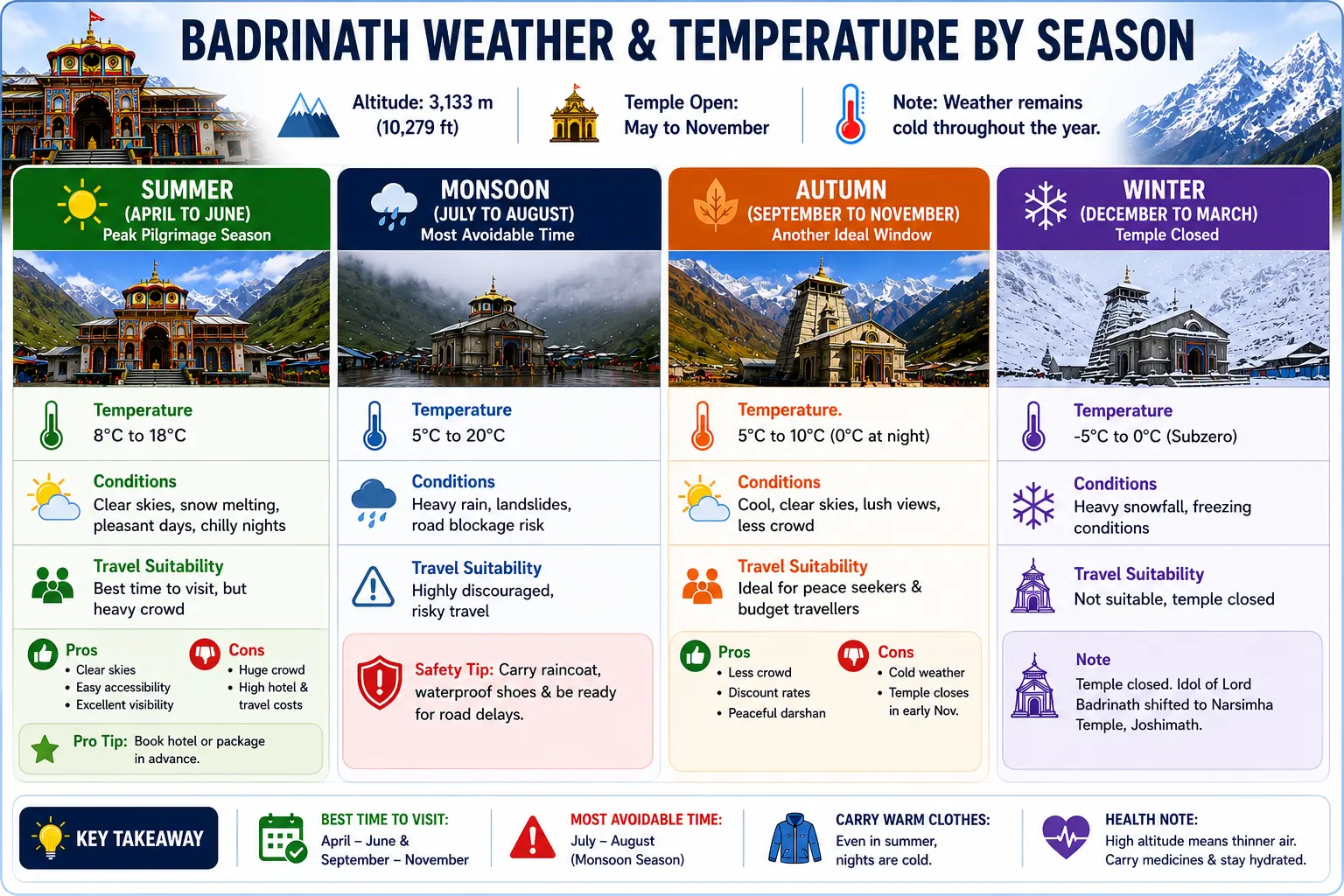
Summer (April to June): Peak Pilgrimage Season
Summer is the best time to visit Badrinath Dham for Darshan. The temple opens after its winter closure and experiences pleasant weather with mild temperatures, especially in the month of May. Badrinath weather in May remains pleasant with comfortable temperatures and clear skies during the day.
- Temperature: Ranges from 8°C to 18°C
- Conditions: Clear skies & trails as the snow melts. Days are pleasant, but nights are still chilly. Accessibility and visibility in Badrinath are excellent, making it one of the most ideal times to visit for families with senior citizens and first-time travellers.
- Travel Suitability: Summer is considered the peak pilgrimage season, favourable for pilgrimage and sightseeing. But higher crowds and long waiting hours for darshan are less ideal for peaceful darshan experience seekers.
- Pros: Clear skies, easy accessibility, and excellent visibility
- Cons: Huge crowd and inflation (high prices) of hotel & transportation rates
Pro tip: Book your hotel or package in advance for a hassle-free experience.
Is there snow in Badrinath in May?
No, in May, the weather in Badrinath becomes pleasant and clear. However, you may see snow patches on the trail in early May and accumulated winter snow on surrounding mountain peaks, like the Neelkanth peaks.
Monsoon (July to August): Most Avoidable Time
The weather in the monsoon season (from July to August) is cloudy and experiences heavy rain, making travel unpredictable for most people. Also, there is a high risk of landslides, road blockage, and mishaps, so it is better to avoid travel during the monsoon.
- Temperature: 5°C to 20°C
- Conditions: Wet season with high humidity and cloudy conditions. Visibility is good, but accessibility is slightly bad due to poor weather. Heavy rain leading to landslides, flash floods, and road blockage
- Travel suitability/who should visit: Travelling during the monsoon is highly discouraged in the mountains. But it can be a time for experienced travellers, nature lovers, and budget travellers.
Safety Tip: If you really plan to go during the monsoon, then keep a raincoat, wear waterproof shoes, and be ready for road delays. Plan with buffer days.
Autumn Season: Another Ideal Window
The Autumn season (September to November) is another good time to visit Badrinath, as the rain starts retreating and the weather becomes pleasant again with a mild temperature range. October is cool and freezing with crisp mountain air. But thinner air and oxygen levels make it less ideal for senior citizens and those with breathing issues.
- Temperature: 5°C to 10°C, drops to 0°C at night
- Conditions: Cool and pleasant weather with lush green landscapes. The crowd level is also lower during this time than in the summer. The views of surrounding peaks and shorter darshan lines are excellent, making it an ideal time for a peaceful Badrinath darshan.
- Travel suitability: Ideal for peace seekers & budget travellers, but less ideal for senior citizens and those who are sensitive to cold weather.
- Pros: Less crowd, discount rates on hotel booking, and a peaceful darshan experience
- Cons: Cold weather and freezing temperatures lead to the closing of the temple in early November. Thinner air and low oxygen levels make it less ideal for senior citizens and those who have breathing issues.
Pro tip: Carry heavy woollens for chilly nights & pack proper medicines for altitude mountain sickness.
Winter In Badrinath (December to March)
Winter in Badrinath is chilly and freezing, with harsh temperatures. The entire region is covered with a thick layer of heavy snow, leading to the closing of the temple.
The temple will be closed for the next six months, and the idol of Lord Badrinath will be gifted to its winter abode in the Narsimha temple in Joshimath for winter worship.
- Temperature: Subzero degrees, 5°C to 0°C
- Conditions: Snow covers everything, and the entire region becomes slightly deserted.
Can I visit Badrinath in winter?
No, you can not visit Badrinath in winter, as the temple gets closed in the winter months (from December to March) due to heavy snowfall and harsh weather.
Generally, it is closed from October/November to March and reopened in late April or early May. If you plan to visit Badrinath in winter, you may see the entire town deserted as the deity is shifted to its winter abode at the Narsingh Temple in Joshimath for winter worship.
Monthly Weather & Temperature Chart
| Month | Day Temperature | Night Temperature | Weather Conditions | Travel Suitability |
|---|---|---|---|---|
| January | 2°C | -8°C | Heavy snowfall, freezing weather | Not Suitable (Temple Closed) |
| February | 4°C | -6°C | Snow-covered landscape, severe cold | Not Suitable (Temple Closed) |
| March | 8°C | -2°C | Snow starts melting, cold days | Limited Access |
| April | 12°C | 2°C | Pleasant weather, occasional snow patches | Limited Access |
| May | 18°C | 5°C | Clear skies, comfortable climate | Best Time to Visit |
| June | 20°C | 8°C | Mild and pleasant weather | Best Time to Visit (Peak Season) |
| July | 18°C | 10°C | Heavy rainfall, landslide risk | Avoid Travel |
| August | 17°C | 9°C | Continuous rain, slippery roads | Avoid Travel |
| September | 18°C | 6°C | Post-monsoon freshness, clear mountain views | Best Time to Visit |
| October | 15°C | 2°C | Cold mornings, crystal-clear skies | Good Time to Visit |
| November | 10°C | -2°C | Cold weather, temple closing period | Limited Access |
| December | 5°C | -6°C | Heavy snowfall begins | Not Suitable (Temple Closed) |
In which month is there snowfall in Badrinath?
In the winter months, from December to March, Badrinath receives heavy snowfall. During this period, the entire region is covered with a thick layer of snow, which makes it inaccessible. The temple gets closed during this period, and the deity is shifted to its winter abode in Joshimath.
Travel Tips for Visiting Badrinath
- Check the temple opening and closing dates before planning a trip
- Carry warm clothes and a raincoat even in summer.
- Avoid night travel as it is not safe in a hilly region
- Keep a buffer day for weather delays in your travel itinerary
- Book your hotel in advance if you visit during the peak season, from May to June.
Final Thought on the Best Time to Visit Badrinath
The opening window of the Badrinath temple is only six months, from May to October. During this period, the best time to go to Badrinath is from May to June for a safe darshan experience and from September to October/early November for a peaceful darshan experience and sightseeing.
May to June experiences huge crowds, but pleasant weather and clear visibility make it the most suitable time for families with young children and senior citizens. While post-monsoon (September to October) is another good time to visit Badrinath Dham, but thinner
In the winter season (December to March), the region experiences harsh weather and heavy snowfall, making the entire region inaccessible.
So yeah, in the end, we say to check the road and weather conditions and follow local safety rules for a safe and comfortable trip.
FAQs
Which month is best to visit Badrinath?
May to June and September to October are the best months to visit Badrinath. If you are planning a trip for the first time or travelling with family, May-June is a great time for a safe journey. If you are looking for a peaceful darshan experience, Post-Monsoon (September to October) is an ideal window with fewer crowds and great accessibility.
Is Badrinath colder than Kedarnath?
No, Badrinath is less cold than Kedarnath, as the altitude is directly correlated with cold weather in the Himalayas. In comparison, Kedarnath experiences harsh weather and subzero temperatures, as it is situated at an altitude of 11,755 feet. Badrinath sits at a slightly lower altitude of around 10,279 feet above sea level and experiences milder and stable weather.
Is the oxygen level low in Badrinath?
Yes, the oxygen level has slightly dropped in Badrinath due to unpredictable weather and a high-altitude location (around 3,133 meters). Thinner air and colder weather at low altitude.
Is Badrinath closed in winter?
Yes, Badrinath is closed in winter due to harsh weather, freezing temperatures, and heavy snowfall, making this region highly inaccessible. The winter months (December to March) are the closing window period for Badrinath. The idol of the deity is shifted to its winter abode in the Narsimha temple in Joshimath for winter worship.
How long is Badrinath open to visitors?
The Badrinath temple is open from May to October to visitors and closed for the rest of the period from November to April due to heavy snowfall.
Is it a good time to visit Badrinath now?
Yes, May to June is a good time to visit Badrinath, as it offers pleasurable weather with great visibility and accessibility.
Does Badrinath have snowfall?
Yes, Badrinath receives heavy snowfall in winter from late November to March. Experiences harsh weather, freezing temperatures, and heavy snowfall, leading to the inaccessibility of the sites.
What is the best time to visit Badrinath with less crowd?
The best time to visit Badrinath with less crowd is during the Autumn season, from September to October, ideal for peaceful Darshan seekers.

Partiksha is a dedicated travel content writer with over 5 years of experience in exploring various destinations in India. From mountains, beaches, treks, to spiritual sites, she believes in sharing experiences through creative storytelling, publishing travel guides, and engaging blogs.
She holds the technique to embrace cultures, stories, mythologies, and various experiences to engage with travellers. With an eye for aesthetics, Partiksha has crafted content that motivates travellers to explore beyond the ordinary itineraries. She doesn’t just write content, but makes it relate to the audience and helps them find what they are looking for.
Her expertise is not limited to writing content, but she also does travel blogging, destination reviews, SEO-friendly travel writing, and creative storytelling that reflects both value and authenticity. She believes that every travel destination has a story worth sharing, which helps to connect people with a place. To make your every visit memorable, she continues to do it through her expertise.



Comments (10)