
Introduction
Panch Prayag, or 5 prayag, refers to five sacred river confluences in the Garhwal Himalayas of Uttarakhand. These five divine confluences are formed along the Alaknanda River, which meets with its tributaries to form the holy Ganga River.
The Panch Prayag includes Vishnuprayag, Nandaprayag, Karnaprayag, Rudraprayag, and Devprayag. Each holds immense significance due to its natural charm and spiritual and mythological story, which attracts many travellers or devotees alike heading towards the revered Kedarnath-Badrinath yatra.
Panch Prayag Uttarakhand, is located on the route to revered pilgrimage shrines, such as Do Dham Yatra, serving as a prominent stopover on the journey. Pilgrims often take a holy bath before their spiritual journey, offering a moment of divinity, reflection, and inner peace.
What is Panch Prayag?
Panch Prayag in Uttarakhand are the five divine merging points where the various tributaries join the Alaknanda River to form the Holy Ganga River.
Here is the Panch Prayag name, from upstream to downstream:
- Vishnuprayag: The first in the series, where the Alaknanda and Dhualiganga rivers meet.
- Nandaprayag: The second point, where the Alaknanda River joins the Nandakini River.
- Karnarprayag: Meeting point of Alaknanda and Pindar rivers
- Rudraprayag: Where the Mandakini river (flows from Kedarnath) joins the Alaknanda river.
- Devprayag: The most significant sangam where the Alaknanda and Bhagirathi rivers meet; that united stream is officially known as the Ganga river.
The word “Panch Prayag” is derived from the Sanskrit word: Panch means “Five”, and Prayag means “confluence” or divine meeting point of rivers. Believed to be a highly auspicious place that holds significance for spiritual cleansing and rituals.
Where is Panch Prayag located?
Panch Prayag Sangam is located in the Garhwal region of Uttarakhand, India. They are situated in the various districts of Uttarakhand, including Chamoli, Rudraprayag, and Tehri Garhwal, ordered from upstream to Downstream, along the path of the Alaknanda river descent towards the plains.
These are the 5 prayag name with location:
- Vishnuprayag: Chamoli District, Uttarakhand
- Nandaprayag: Chamoli District, Uttarakhand
- Karnarprayag: Chamoli District, Uttarakhand
- Rudraprayag: Rudraprayag District, Uttarakhand
- Devprayag: Tehri Garhwal District, Uttarakhand
Panch Prayag Map
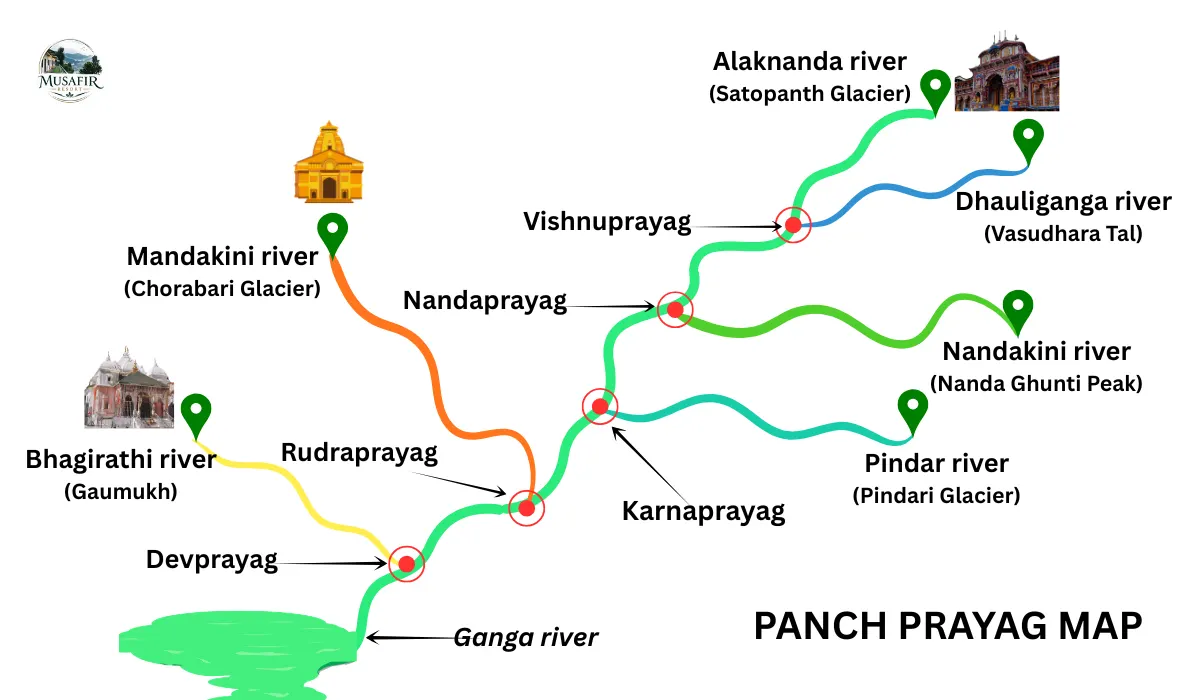
The Panch Prayag map follows the main route in Uttarakhand, the NH-7, starting from Rishikesh and proceeding to Badrinath, connecting all 5 prayag of Ganga.
Common route: Rishikesh → Devprayag → Rudraprayag → Karnaprayag → Vishnuprayag
Below is the Panch Prayag map with distance: starting from Rishikesh to Badrinath
- Devprayag: Located in the Tehri Garhwal district, around 69.3 km from Rishikesh, it is considered the last holy confluence, the beginning point of the Panch Prayag tour.
- Rudrapryag: Located around 65 km from Devprayag, within the Rudraprayag district, on the way to the Kedarnath Temple route.
- Karnaprayag: Located around 32 km from Rudraprayag, where the Pindar river meets the Alaknanda river, known as Karnaprayag Sangam.
- Nandaprayag: Approximately 21 km from Karnaprayag, a less crowded confluence offers a calm retreat.
- Vishnuprayag: Located around 71 km from Nandaprayag, it is the first confluence according to the descending river system.
What is the story of Panch Prayag?
The Panchprayag story is tied to the legend of the Holy Ganga River’s descent to earth from heaven. According to Hindu mythology, King Bhagirath performed intense penance to bring the Ganga down to purify the sins of his ancestors.
Ganga was ready to descend to bless all humankind. But the force of descent was too much for the world to handle.
After this, to temper this force, Lord Shiva caught her in his matted hair and split her force into twelve channels, and the Alaknanda River is one of the major streams that flows through the Garhwal Himalayas.
This major stream meets with other tributaries at five distinct points, collectively known as Panch Prayag Sangam, to form the Ganga River.
Each river confluence has its own mythological story and spiritual significance. Let’s know about all 5 Prayag in Uttarakhand.
About Panch Prayag Sangam
Vishnuprayag: Confluence of Alaknanda & Dhauliganga
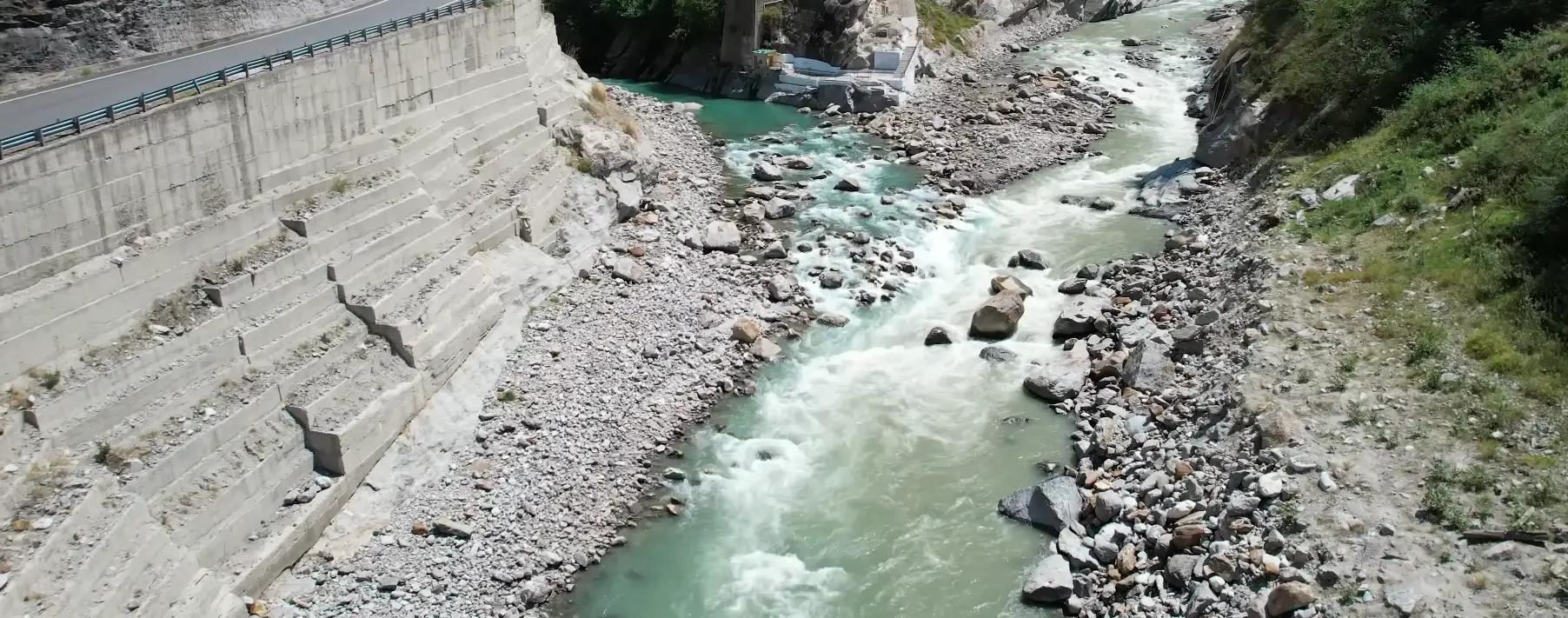
Vishnuprayag, the first among the Panch Prayag Uttarakhand, is located in the Chamoli district, near Joshimath. The meeting point of the Alaknanda and Dhauliganga rivers. It widely holds importance for its scenic beauty and ancient legend. Featuring an ancient Vishnu Temple and a breathtaking view of peaks.
- Location: Chamoli district in Uttarakhand
- Altitude: 1,372 meters (4,500 feet)
- Significance: According to mythology, it is believed to be a place where sage Narad performed intense penance of Lord Vishnu to gain divine knowledge. By pleasing his devotion, Lord Vishnu blessed him with the cosmic energy. After this, the place is named Vishnu Prayag.
Note: Know more about Vishnuprayag Sangam
Nandaprayag: Sangam of Alaknanda & Nandaikini Rivers
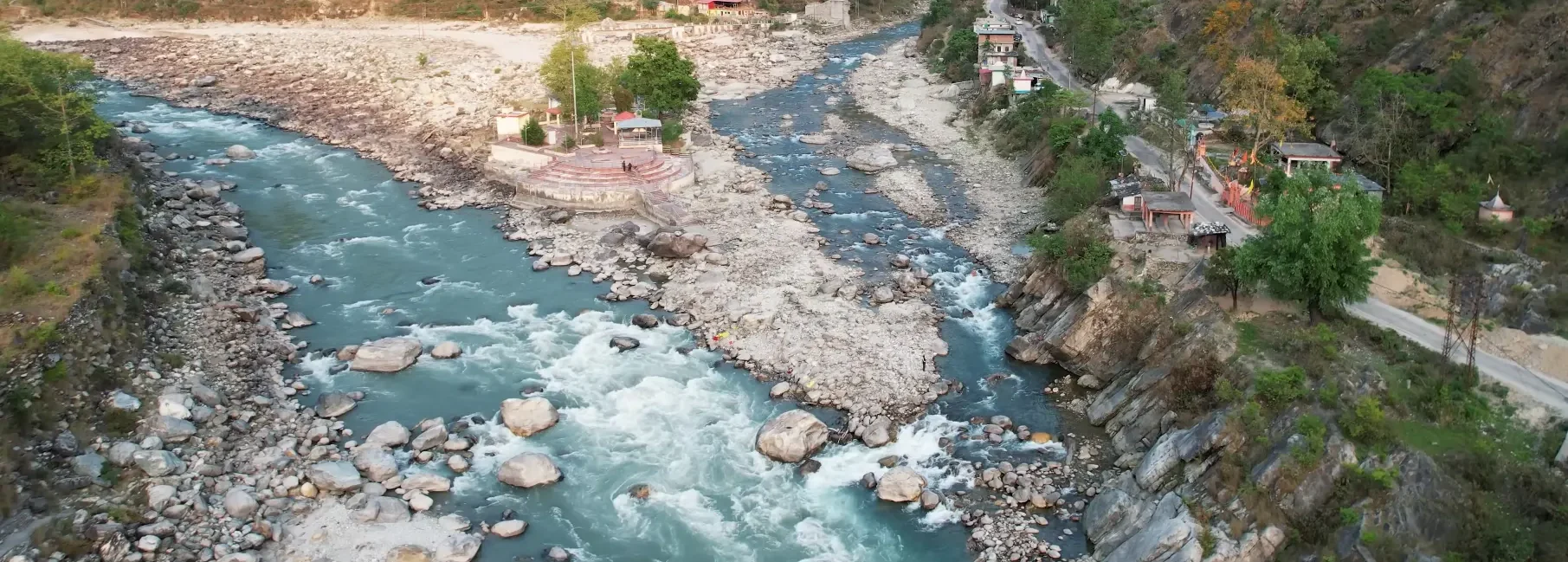
Nandprayag, another divine confluence of the Alaknanda and Nandakini rivers, is located in the Chamoli district of Uttarakhand on the way to the Badrinath temple. It is named after King Nanda (the foster father of Lord Krishna), known for its serene and scenic atmosphere.
- Location: Chamoli district, Uttarakhand
- Altitude: 1,358 meters (4,455 feet)
- Significance: It is believed that Nandaprayag is the place where King Nanda performed a grand Yajna (fire ritual) to appease Lord Vishnu as his son. Lately, Vishnu granted his wish and took the incarnation of Lord Krishna in the Dwapar yug. The ancient Gopalji temple, dedicated to Lord Krishna, is a spiritual landmark of the site.
Also Read: Nandaprayag Sangam Uttarakhand
Karnaprayag: Meeting Point of Alaknanda & Pindar Rivers
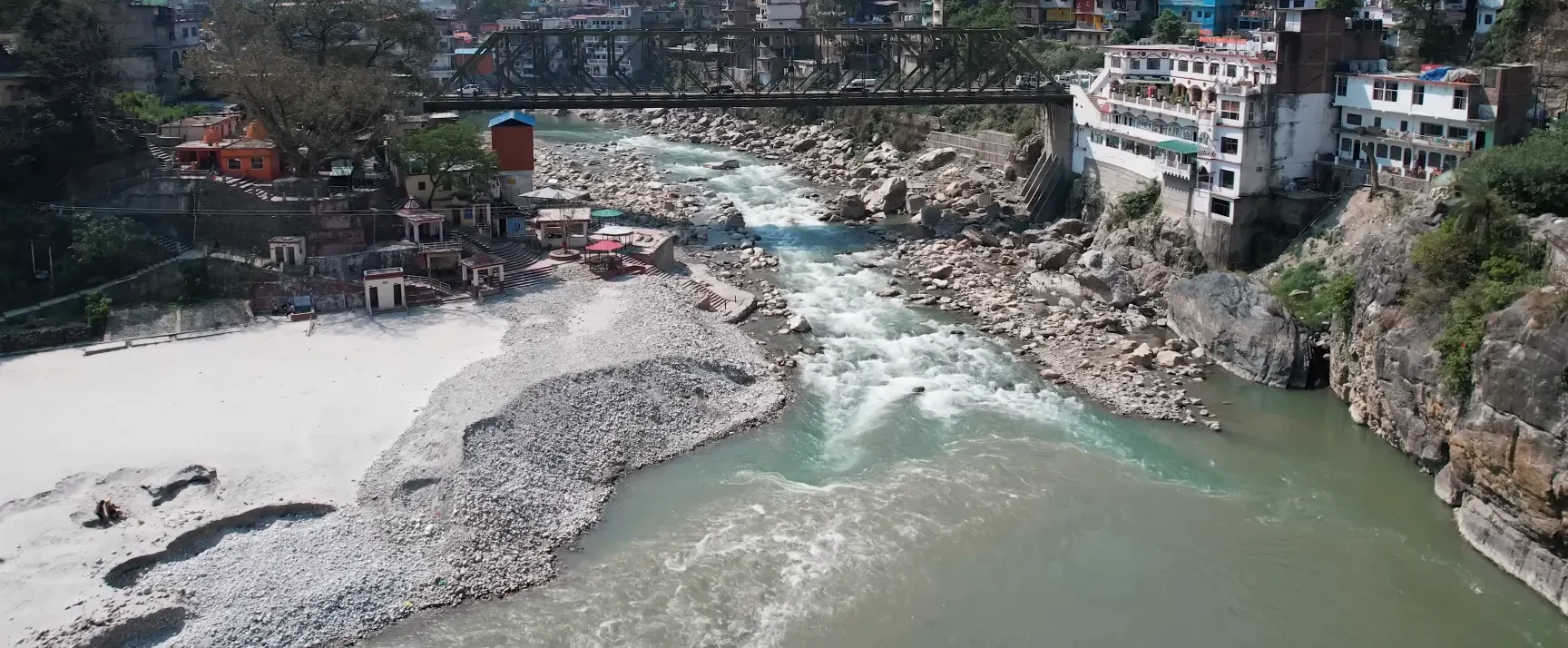
Karnaprayag is a serene Himalayan town, located around 21 km from Nandprayag. Known as the sacred meeting point of the Alaknanda and Pindar rivers. Situated at an altitude of 860 meters, it serves as a key stop for the Badrinath yatra. Ties with the legends of the Mahabharata. Famous for ancient temples, like Uma Devi Temple and Chandika Devi Temple.
- Location: Chamoli district of Uttarakhand
- Altitude: 860 meters (2,820 feet)
- Significance: Believed to be a place where Karna from the Mahabharata worshipped the sun God (Surya) to get the protective armour (Kavach). Also, a place where Lord Krishna performed Karna’s funeral rituals at this sacred site.
Read More: Karnaprayag Sangam in Uttarakhand
Rudraprayag: Confluence of Alaknanda & Manakini
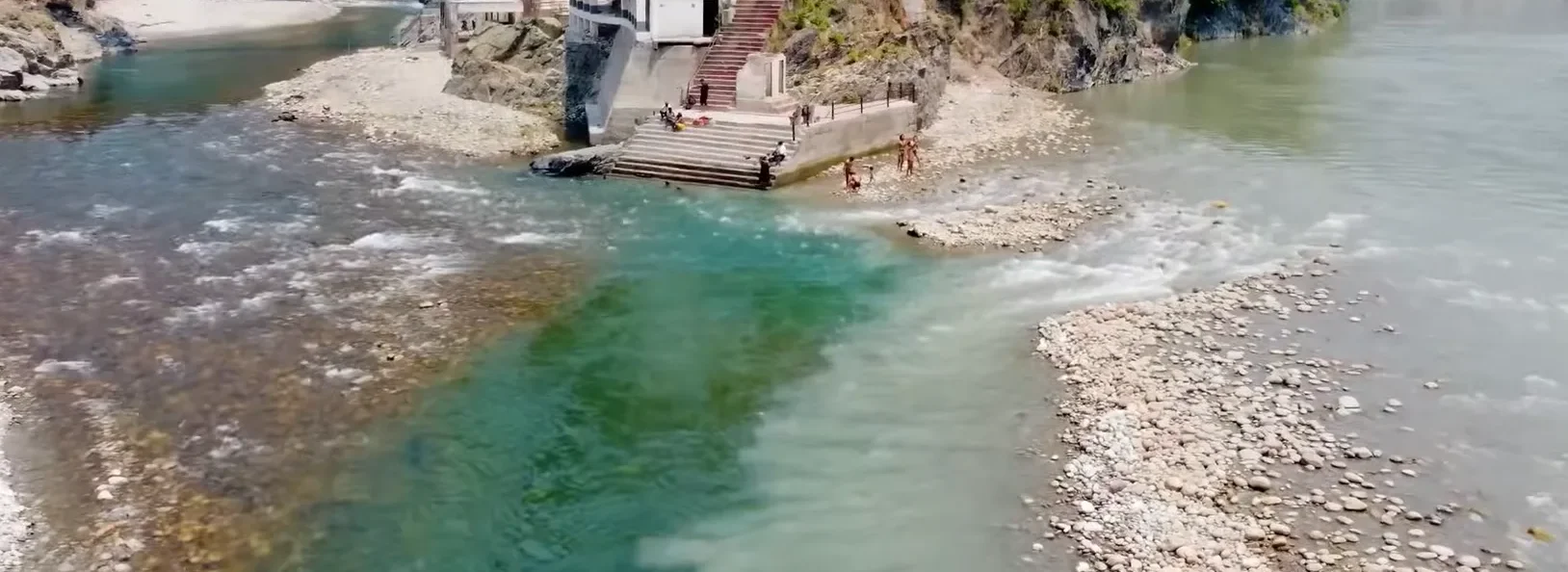
Rudraprayag is a divine place; the Mandakini River, which flows from Kedarnath, joins the Alaknanda River. It is also a prominent district headquarters serving as a key halt point for pilgrimage on the way to the Kedarnath temple. Offering panoramic views of lush green peaks and known for some ancient temples, like the Rudranath temple.
- Location: Rudraprayag district, Uttarakhand, within the Garhwal Himalayas
- Altitude: 895 meters (2,936 feet)
- Significance: Rudraprayag is named after the Lord Shiva’s Rudra avatar, who appeared to the sage Narada, who performed intense penance and got the blessing of Mastery in the mysteries of music.
Also Read: Rudraprayag Sangam
Devprayag: Confluence of Alaknanda & Bhagirathi Rivers
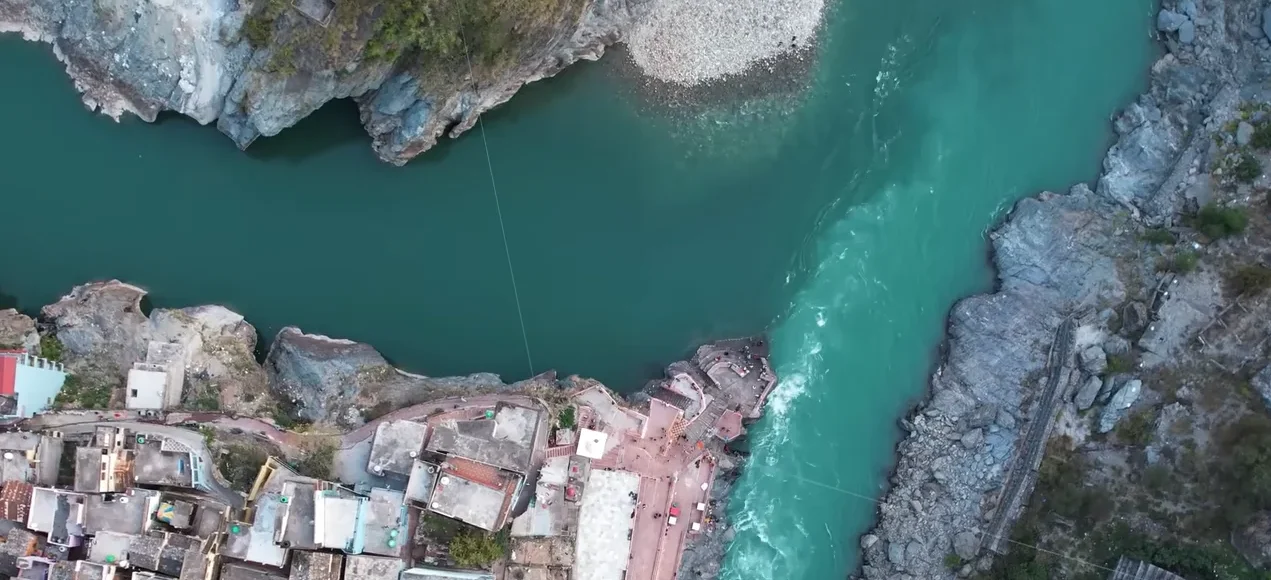
Devprayag is the final and most significant confluence among the Panch Prayag map, where the Alaknanda meets the Bhagirathi, and their meeting point is known as the origin point of the Ganga River. In the Tehri Garhwal district, around 69 km from Rishikesh, Devprayag is considered the official birthplace of Maa Ganga.
- Location: Tehri Garhwal district, Uttarakhand
- Altitude: 830 meters above sea level
- Significance: Local belief holds that Devprayag is a place where King Dashrath performed penance, and Lord Rama meditated after killing Ravana, making it a sacred site featuring the Dashrath Shila, Raghunath ji temple, and suspension bridges.
Know More: About Devprayag Sangam
Best Time To Visit Panch Prayag
Well, all five river confluences are accessible all year. But the best time to visit Panch Prayag of Uttarakhand is from April to June and September to November, as these periods offer pleasant weather and great accessibility for travel and sightseeing.
Below is a breakdown of the best time to visit Panch Prayag:
Summer (April to June): The most pleasurable time is during the peak Chardham yatra season. Offer stable weather and temperatures ranging from 20°C to 30°C, with great views, ideal for a pilgrimage.
Monsoon (July to August): It is a risky time to travel, as it experiences heavy rain that causes landslides and roadblocks, making travel hectic.
Autumn (September to November): Another ideal time with a temperature range between 10°C and 20°C, experiences fewer crowds, and provides a peaceful experience. Good for travel and outdoor activities
Winter (December to March): It experiences cold weather with temperatures dropping to sub-zero degrees at night, making it suitable only for travellers comfortable with a cold atmosphere.
How To Reach Panch Prayag
All Panch Prayag of Uttarakhand are located along the NH-7, known as the Rishikesh-Badrinath National Highway. So the most logical way to start the Panch Prayag tour is from Haridwar or Rishikesh, which have great connectivity to all major Indian cities.
Quick overview of core transit connectivity:
By Air: Jolly Grant Airport is the nearest airport to these sacred sites. Around 20 km from Rishikesh. From there, you can take a local bus or taxi to begin your journey.
By Train: Haridwar and Rishikesh stations are the nearest railheads, having great connectivity to all major indian cities. From either of these stations, proceed on a road journey for further travel.
By Road: NH-7 is the primary route that connects all five prayags. You can take a UTC bus or a private taxi from Rishikesh, Haridwar, or Dehradun, or self-drive vehicles for the entire journey.
Panch Prayag Route Map Guide
Here is a step-by-step overview of the Panch Prayag route map by road:
Route: Devprayag → Rudraprayag → Karnaprayag → Nandprayag → Vishnuprayag
- Drive to Devprayag: Reach Rishikesh first via train or road travel. From there, take a local bus or shared taxi to Devprayag first, which is around 70 km from there. Devprayag is the official starting point of the Panch Prayag yatra.
- Devprayag to Rudraprayag: After visiting Devprayag, drive to Rudraprayag, around 66 km further away. Take a holy bath at the Alaknanda and Mandakini river sangam.
- Rudraprayag to Karnaprayag: Drive on the same NH-7 route, covering a distance of around 33 km to reach Karnaprayag, where the Pindar river originates from the Pindar glaciers and meets with the Alaknanda river.
- Karnaprayag to Nandprayag: Drive around 21 km towards the Chamoli district and witness the divine confluence of the Alaknanda and Nandakini rivers.
- Nandprayag to Vishnuprayag: The highest confluence among 5 prayags, needed a drive of around 70 km from Nanaprayag to reach the very first confluence of the Alaknanda and Dhauliganga rivers.
Travel duration: A dedicated journey to all five prayags takes over 3-4 days with essential halts. And 8-10 days along with the Do Dham or Char Dham circuit.
Note: Check out our Kedarnath private package to cover these five holy confluences with a sacred Kedarnath yatra.
Travel & Safety Tips for Visitors
- Pack Essentials: Carry light clothes in summer and woollens in autumn and winter, documents, medicines, a power bank, and other miscellaneous things.
- Start Trip Early: Due to hilly terrain and heavy traffic during the peak season, start your journey early.
- Book Stays in Advance: Panch Prayag Sangam serves as a crucial stopover point for travellers on the Do Dham or Char Dham yatra. Book your stay well in advance to avoid last-minute hassle.
- Weather Consideration: Check the weather before travel, as it changes rapidly in the mountains.
- Respect Sites: Follow the local customs and respect the culture and environment for an enjoyable experience.
Conclusion
A journey to the sacred Panch Prayag Uttarakhand is a spiritual path that brings travellers closure to nature and divinity. It starts from the plains of Rishikesh and passes through Devprayag, Rudraprayag, Karnaprayag, Nandaprayag, and Vishnuprayag, following the one primary route, NH-7.
The essence of watching the merging rivers and the calmness of the mountains is a unique experience that lies forever.
It is highly believed that witnessing the 5 Prayag of holy confluences is highly auspicious, and taking a bath in holy water purifies the souls of visitors and brings salvation.
Faqs
What are the 5 Prayag of Uttarakhand?
The 5 prayag of Uttarakhand refer to the five sacred river confluences in the Garhwal Himalayas of Uttarakhand. These are the meeting points of the Alaknanda River that merge with their tributaries to form the Holy Ganga River. From upstream to downstream, Panchprayag are: Vishnuprayag, Nanaprayag, Karnaprayag, Rudraprayag, and Devprayag.
How to complete the Panch Prayag order?
To complete the Panch Prayag map in order, you must travel to Rishikesh first, a practical starting point for the trip, and drive from downstream (Devprayag) to upstream (Vishnuprayag).
Here are the standard routes for the Panch Prayag route map:
Rishikesh → Devprayag → Rudraprayag → Karnaprayag → Nandaprayag → Vishnuprayag
Follows the NH-7 route, the Rishikesh-Badrinath national highway.
Which prayag is nearest to Rishikesh?
Devprayag is the nearest Prayag to Rishikesh, located approximately 70 km away, and generally takes around 2-3 hours by road.
How many Sangams are there in Uttarakhand?
There are five holy sangams in the Garhwal region of Uttarakhand, often known as “Panch Prayag”, including Vishnuprayag, Nandprayag, Karnaprayag, Rudraprayag, and Devprayag.
Which is better, Rudraprayag or Devprayag?
Well, both river confluences have their own charm and spiritual importance. Both are serving as crucial stopover points for pilgrimage, such as Kedarnath. Rudraprayag is a divine meeting point of the Alaknanda and Mandakini rivers, while Devprayag is the fifth confluence of the Alaknanda and Bhagirathi rivers.
What is the legend behind Panch Prayag?
The legend behind Panch Prayag in Uttarakhand is tied to the penance of King Bhagirath, who wanted to please Maa Ganga to descend on earth to bless his ancestors. Gana was ready to descend from heaven, but her powerful split could destroy the world, so Lord Shiva tied it into his matted hair and split it into 12 multiple streams, which later formed the Holy Ganga that holds significance for purification and liberation.

Partiksha is a dedicated travel content writer with over 5 years of experience in exploring various destinations in India. From mountains, beaches, treks, to spiritual sites, she believes in sharing experiences through creative storytelling, publishing travel guides, and engaging blogs.
She holds the technique to embrace cultures, stories, mythologies, and various experiences to engage with travellers. With an eye for aesthetics, Partiksha has crafted content that motivates travellers to explore beyond the ordinary itineraries. She doesn’t just write content, but makes it relate to the audience and helps them find what they are looking for.
Her expertise is not limited to writing content, but she also does travel blogging, destination reviews, SEO-friendly travel writing, and creative storytelling that reflects both value and authenticity. She believes that every travel destination has a story worth sharing, which helps to connect people with a place. To make your every visit memorable, she continues to do it through her expertise.



Comments (10)